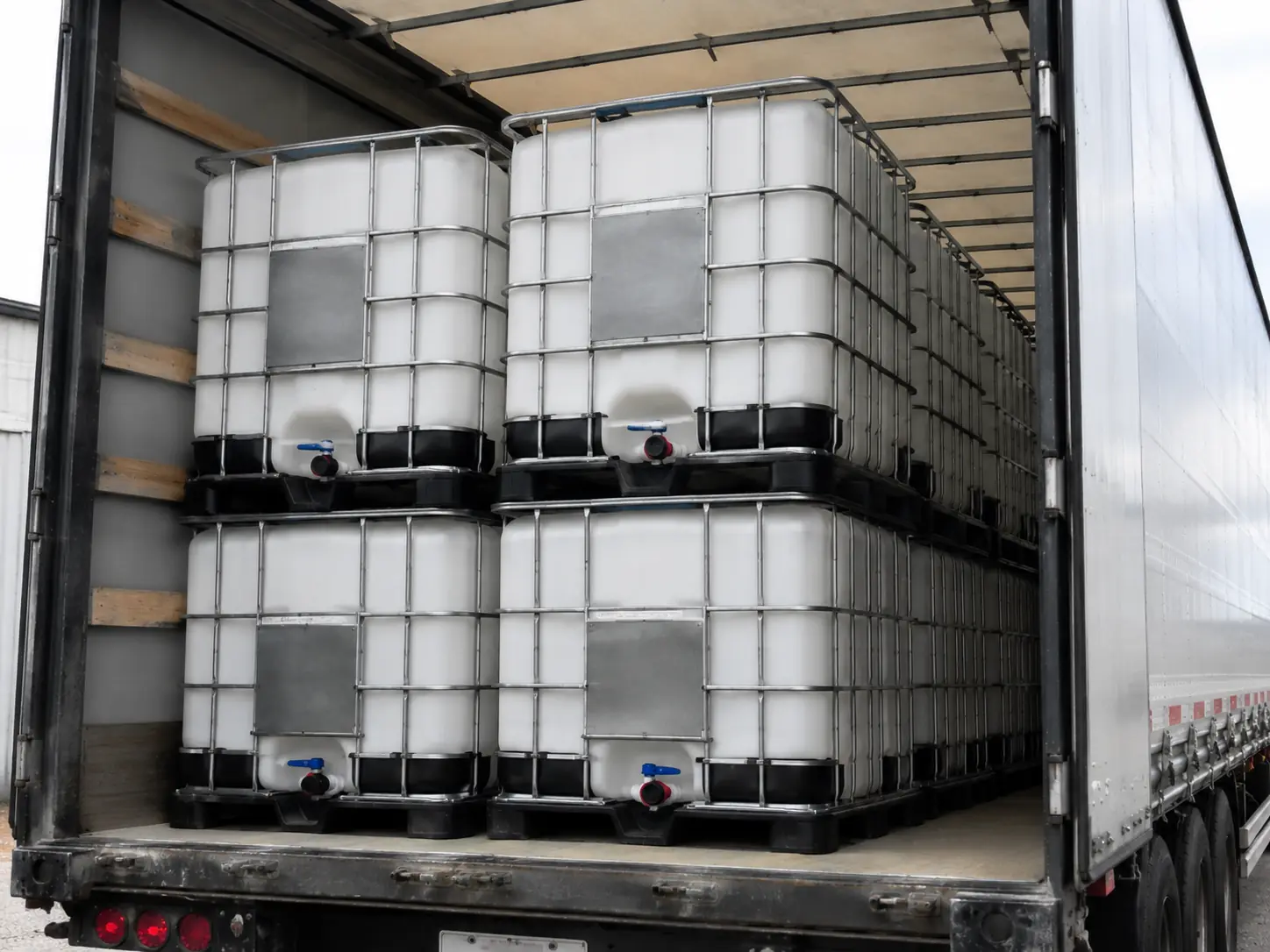
Of every container we grade down on arrival, ultraviolet degradation is the single biggest cause — ahead of handling damage, ahead of contamination, ahead of everything. It is also the cheapest to prevent and the most consistently ignored.
What UV does to HDPE
Ultraviolet photons carry enough energy to break carbon–carbon and carbon–hydrogen bonds in the polymer backbone. The resulting free radicals react with atmospheric oxygen, and the chain reaction that follows shortens the polymer chains and introduces carbonyl groups into the structure.
The practical consequences, in order of appearance: the surface goes chalky and loses gloss; the material loses ductility and impact resistance; micro-cracks form at the surface; and finally the wall cracks under a load it would have shrugged off when new.
Natural, unpigmented HDPE — which is what nearly every tote bottle is — has essentially no UV protection. Pigmented and carbon-black-loaded grades are dramatically more resistant, which is why black water tanks outlive white ones by years.
The New York timeline
- One summer uncovered — measurable surface chalking, no meaningful loss of strength. Cosmetic.
- Two summers — visible chalking, reduced impact resistance. A forklift nudge that would have bounced now marks or holes the bottle. This is where we start grading down.
- Three to four summers — brittleness you can feel. Thumbnail pressure leaves a permanent white stress mark. Grade C at best.
- Five or more — assume the bottle is finished. The cage is usually fine, which makes it a rebottling donor.
The thumbnail test
Press a thumbnail firmly into the sidewall away from any moulding line. A healthy bottle takes a faint mark that recovers within a minute. A degraded one keeps a white stress mark, and if you rub the surface and get chalk on your fingers, that container has been outside for at least two summers.
Heat, separately
Temperature is a second, compounding problem. HDPE creeps — deforms slowly under sustained load — and creep rate rises sharply with temperature. This is exactly why the UN stacking test for plastics is run at 40°C for 24 hours rather than at room temperature.
A dark yard in Queens in August is not far off that. A stack that is entirely stable in March can slowly deform through a heatwave, and the deformation does not reverse when it cools. If you stack outdoors, take a container off the stack for summer.
What prevention costs
A simple lean-to or a run of shade cloth over a storage row is a few hundred dollars and adds years to every container under it. A tarpaulin is worse than nothing if it traps moisture against the bottle, but a raised cover with airflow is excellent.
For containers holding product long-term outdoors, an opaque cover or a coat of exterior paint solves UV and algae in one afternoon. Algae is the other reason clear bottles should not sit in the sun with water in them.
Against that, a container dropped from Grade A to Grade C loses roughly $130 of value. The shade cloth pays for itself across three containers.
Danny Foulkes is the yard manager at IBC Tote Recycling NY in Astoria, Queens. We publish the figures we work from — if you think one of them is wrong, tell us.