Knowledge · Compliance
What the rules actually require in New York.
Ask a compliance question
Replies within one business day · Fields marked * are required
49 CFR 180.352
The retest clock, and how it is missed.
The clock starts at the date of manufacture, which is the four-digit block in the UN marking. Nobody sends you a reminder.
| Interval | What is required | Recorded where | Consequence of missing it |
|---|---|---|---|
| Every 2.5 years | Leakproofness test plus external visual inspection of the body, closures and structural equipment | Retest marking on or near the UN plate, plus the owner's records | Not authorised for regulated product until requalified |
| Every 5 years | Full periodic inspection including internal examination, in addition to the leakproofness test | Retest marking and records | Same — the container leaves dangerous-goods service |
| After repair or rebottling | Requalification against the design type before return to service | New marking issued by the reconditioner | Container cannot carry regulated goods |
The mistake almost everyone makes
Buying a container with a beautiful, legible original UN plate and assuming it is authorised. The design-type marking says the container was built to an approved and tested design. It says nothing about whether anyone has tested this specific unit in the last two and a half years.
Look for the retest marking, which is separate and usually adjacent. If it is absent on a container older than 2.5 years, the unit is fine for non-regulated use and not authorised for anything else. That is exactly why our Grade B and C categories exist, and why they are priced the way they are. Learn to read both marks on the decoder page.
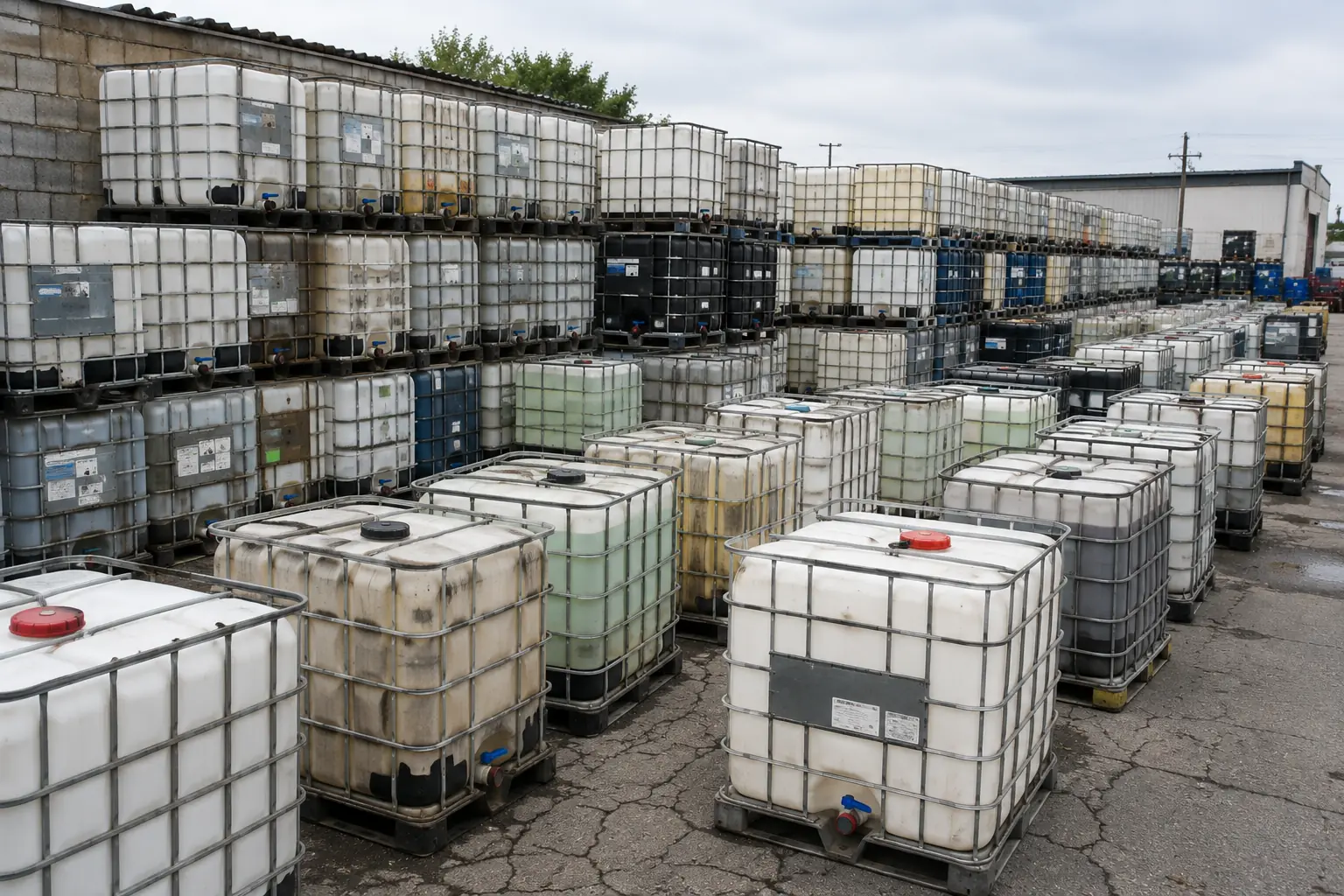
Storing totes in New York City
Water and non-hazardous product: no permit, just common sense about load bearing and access. Everything else depends on the class and quantity.
- Flammable and combustible liquids. The FDNY Fire Code governs, and permits are typically required above threshold quantities that vary by liquid class and building occupancy. A single 275-gallon tote of a Class I flammable will usually be over the line. Ask FDNY first — retrofitting compliance after an inspection is far more expensive than a phone call.
- Hazardous materials. May bring in DEC and DEP obligations alongside the Fire Code, particularly around spill reporting and stormwater.
- Outdoor storage. Watch stormwater. A leaking tote on an uncovered yard that drains to a storm sewer is a discharge, and it is treated as one.
- Load bearing. A full 275 is 2,425 lb on roughly 13 square feet. On an upper floor or a mezzanine, get that checked rather than assumed.
Secondary containment
The working standard is 110% of the largest single container — 303 gallons for a 275-gallon tote. Bund pallets are the purpose-made answer; a cut-down tote makes an entirely adequate tray for static storage at a fraction of the cost. Where containment is not strictly required, fit it anyway: the cost of a bund is trivially less than the cost of a cleanup, and immeasurably less than the cost of a discharge into a storm drain.
Waste transfer and empty containers
Commercial waste in New York moves through licensed carters with documentation, and an “empty” container is not empty — the heel retains the classification of the product. Putting totes in a skip is both a paperwork problem and a waste of an asset worth $18–$95 each.
The straightforward route is to sell them: you get paid, you get a transfer note listing every serial, and the containers go back into service. Where they genuinely must be removed from circulation, that is certified destruction with a numbered certificate.
How often must an IBC tote be retested?
For a composite IBC in dangerous-goods service under 49 CFR 180.352: a leakproofness test and external inspection every 2.5 years, and a full periodic inspection including internal examination every 5 years, measured from the date of manufacture. Miss the window and the container is not authorised for regulated product until it is requalified.
Do I need a permit to store IBC totes in New York City?
It depends entirely on what's in them. Water needs nothing. Flammable and combustible liquids fall under the FDNY Fire Code and typically require a permit above threshold quantities, with the thresholds varying by class and occupancy. Hazardous materials may also trigger DEP and DEC obligations. Check with FDNY before you site drums or totes of anything flammable.
Is secondary containment required?
For many regulated liquids, yes — and the usual standard is capacity for 110% of the largest single container, which for a 275-gallon tote means a bund holding at least 303 gallons. Even where it is not strictly required, it is the cheapest insurance available, and a cut-down tote makes a perfectly good bund tray.
Can I just put empty totes in a skip?
No. An 'empty' container retains a heel with the hazard classification of the product, and commercial waste in New York must move through a licensed transfer route with documentation. It is also a waste of a container worth $18–$95. Sell them instead.
Not sure whether your fleet is in date?
Send us photographs of the plates. We'll tell you which containers are current, which need requalification, and which have quietly dropped out of dangerous-goods service.