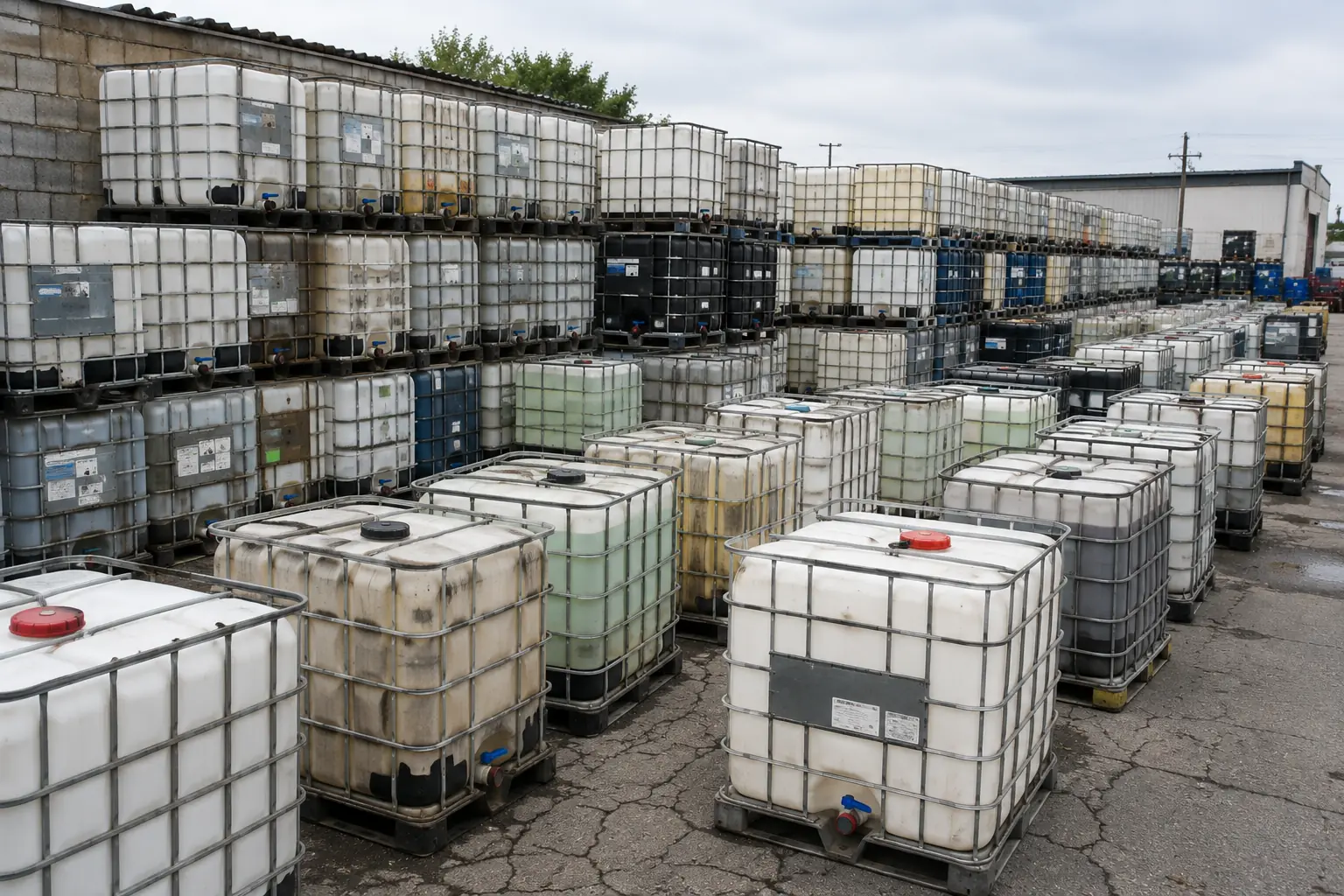
Our story · Environmental mission
Recycling is the fourth-best thing you can do with a tote.
Ask for your own numbers
Replies within one business day · Fields marked * are required
The reuse ladder
Five rungs, in strict order.
We work down this list and stop at the first rung that is genuinely available. Most of the industry starts at rung four and calls it environmental leadership.
| Rung | Outcome | CO₂e avoided | Virgin HDPE avoided | Steel avoided | Share of our intake |
|---|---|---|---|---|---|
| 01 | Reuse as-is (recondition) | 125 kg | 17 kg | 42 kg | ~69% |
| 02 | Rebottle | 78 kg | 0 kg | 42 kg | ~11% |
| 03 | Harvest parts | Varies | Partial | Partial | ~4% |
| 04 | Granulate and smelt | 46 kg | 17 kg | 42 kg | ~15% |
| 05 | Landfill | 0 kg | 0 kg | 0 kg | <1% |
The greenest container is the one that already exists
Every environmental claim in packaging eventually reduces to this. A container that has already been manufactured has already emitted its embodied carbon; using it again amortises that cost over more service cycles. Nothing you can do with virgin resin — no bio-content, no lightweighting, no recyclability claim — competes with simply not making a new one.
Recycling is a failure state, not an achievement
The industry has spent thirty years training everyone to treat recycling as the good outcome. It is the fourth-best outcome. Granulating a sound tote recovers its material and destroys the manufacturing energy invested in it — you get 46 kg CO₂e back where reuse would have given you 125. We describe recycling as what we do when we have failed to find a better answer.
Claims need arithmetic behind them
Most sustainability marketing in this trade is unfalsifiable — 'eco-friendly', 'green solutions', 'committed to the planet'. We publish our factors, show the subtraction for collection and washing, and round every figure down. If a number cannot survive someone checking it, it should not be on a website.
Repairability is an environmental property
A composite tote is two components with wildly different lifespans: a consumable bottle and a near-permanent steel cage. That single design decision is why these containers dominate the reuse market and why a one-piece tank, however recyclable, is environmentally worse. Design for disassembly beats design for recycling.
Local beats optimal
A tote hauled 400 miles to a marginally better reconditioner has burned the saving on the way there. Our radius is about 75 miles from Astoria and we refer work outside it rather than chase it. An empty backhaul is bad economics and worse carbon, and the fact that this also happens to be convenient does not make it untrue.
Where the numbers come from
A 275-gallon composite tote on a steel pallet has a tare of about 59 kg: roughly 17 kg of blow-moulded HDPE in the bottle and 42 kg of galvanised steel in the cage and frame.
- Virgin HDPE, cradle-to-gate: 1.9 kg CO₂e/kg, about 76 MJ/kg.
- Virgin galvanised steel, BOF route: 2.2 kg CO₂e/kg, about 25 MJ/kg.
- Reconditioning charge: ~15 kg CO₂e per unit for heated wash water, caustic, local collection and the return leg.
That gives (17 × 1.9) + (42 × 2.2) = 124.7 kg of embodied burden avoided, plus a manufacturing and inbound-transport allowance, minus the 15 kg it costs us to bring one back. We publish 125 and we round every component down.
What we deliberately do not claim
We do not claim carbon neutrality, we do not buy offsets and present them as reductions, and we do not count the same tonne twice by claiming both the reuse saving and a recycling credit. We also do not claim the downstream benefit when a customer uses a tote for something greener than what it held before — that saving is theirs, not ours.
If you need it audited
The calculator gives you an order-of-magnitude figure suitable for an internal report. For a CDP submission, a Scope 3 line item or a customer audit, ask us for the per-shipment worksheet and we will build it from your actual manifest — real containers, real distances, real wash cycles — rather than from averages.
Beyond the containers
- Rinsate captured, characterised and sent to permitted treatment — never to drain.
- Wash water recirculated through settlement before make-up.
- Collections consolidated geographically rather than run as single-unit chases.
- Grade C containers routed to upcycling before granulation.
- Yard lighting and the wash-line heaters on a time-of-use schedule.
- Community gardens and schools supplied at cost.
Run your own numbers
What does your operation actually save?
Slide it to whatever you move in a year. The factors above are what drive it.
How we got there. Cradle-to-gate burden of the virgin container (17 kg HDPE at 1.9 kg CO₂e/kg, 42 kg galvanised steel at 2.2 kg CO₂e/kg) minus the real cost of bringing one back: collection, caustic wash, rinse, leak test and the return leg, about 15 kg CO₂e a unit. We round every figure down. Treat it as an order-of-magnitude guide for a sustainability report, not a verified LCA — if you need a defensible number for CDP or a Scope 3 filing, ask us for the per-shipment worksheet and we'll build it from your actual manifest.
Is reusing a tote really better than recycling it?
Substantially. Reusing a 275-gallon composite tote avoids roughly 125 kg CO₂e against buying the equivalent new — 17 kg of virgin HDPE and 42 kg of galvanised steel that never have to be made. Granulating the same tote recovers the material but you still pay the full energy cost of remoulding and re-smelting, so the net saving drops to around 46 kg. Reuse first, recycle last.
What actually happens to a tote you can't resell?
It gets stripped rather than skipped. The bottle is rinsed, granulated and sold into non-food durable goods. The cage and pallet frame go to a steel mill. Valves and gaskets are separated into their own streams. About 94% of the mass leaves our yard as a recovered material; only genuinely non-recoverable residue is disposed of.
Can I get avoided-emissions numbers for my sustainability report?
Yes. Our impact calculator gives you an order-of-magnitude figure immediately. For anything that has to survive scrutiny — a CDP submission, a Scope 3 line, a customer audit — ask us for the per-shipment worksheet and we will build it from your actual manifest rather than from averages.
More on the full FAQ, and the year's figures in the 2025 impact report.
Want the worksheet for your own shipments?
Tell us roughly what you move and we'll build the avoided-emissions figures from your real manifest rather than from averages.