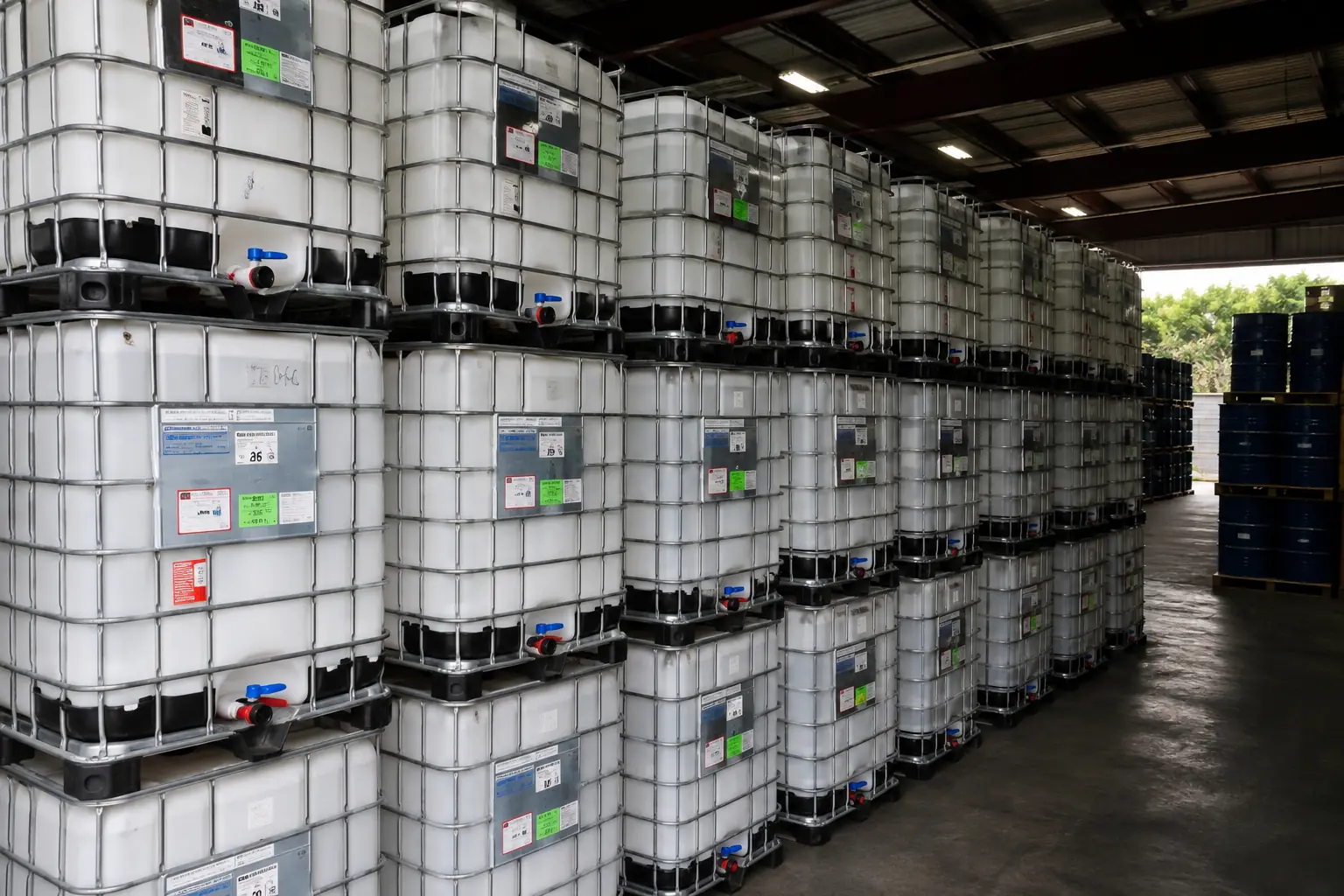
Totes & products · From $210
Food-Grade IBC Totes
Check stock and pricing
Replies within one business day · Fields marked * are required
A tote is not food grade because it looks clean
This is the single most misunderstood thing in the used container trade, and it costs people real money. Food grade is not a description of appearance and it is not a property of the plastic on its own. It is a claim about history, and a claim about history requires evidence.
- The bottle must be virgin HDPE suitable for food contact — not regrind, however clean.
- The container's entire prior life must have been food, and someone must be able to prove it.
- The cleaning must have happened on equipment that never touches industrial chemistry.
Miss any one of the three and the term is marketing. We have seen totes sold as food grade whose only qualification was that somebody pressure-washed them.
Why a chemical tote can never come back
HDPE is permeable to many organic compounds. A solvent that has been sitting in a bottle for six months has not merely coated the inside surface — it has migrated into the polymer wall, and it will leach back out into whatever you put in next, slowly, for years. No wash cycle reaches it because it is not on the surface. This is why our answer to "can you make this food grade again" is always no, and why you should be suspicious of anyone whose answer is yes.
What the dedicated line means in practice
Not a scheduled slot on the same equipment. A different bay, different spray heads, different chemistry, and no solvent work ever run through it. Cross-contamination in a wash line is invisible and untraceable, so the only defensible control is physical separation.
The verification step
The final rinse is tested for total organic carbon and has to come back below 5 ppm. That is a measurement, not an opinion, and it goes on the certificate with the serial number. Units are then hot-air dried under filtered air and sealed immediately — because standing water in a warm sealed container grows biofilm faster than most of what you were planning to store.
If you need a virgin bottle specifically
Some audits require the bottle itself to have never held anything, regardless of what it was. That is a rebottled unit, not a used food-grade one — a new bottle in a reclaimed cage, with the virgin-resin documentation to prove it. It costs more and it is still far greener than buying new.
Typical buyers
Beverage and syrup producers, edible oil handlers, flavour and fragrance houses, cosmetic and personal-care manufacturers, nutraceutical blenders, and — increasingly — municipalities and emergency services buying potable water storage. Hunts Point and the Sunset Park food cluster supply a lot of our incoming stock, which is one reason our food-grade availability is better than most yards our size.
Can I store drinking water in one?
In a documented food-grade unit, yes, treating it as storage rather than indefinite supply. In a Grade B industrial tote, no — not after any amount of scrubbing, because you cannot rinse out permeation.
What paperwork comes with it?
Prior-contents declaration from the original filler, the wash certificate with the TOC result, the leakproofness test record, and photographs of the interior. All keyed to the serial number.
Why is food-grade stock so much harder to get?
Because it depends entirely on what the local food trade released that month, and because a single-trip food history is destroyed the moment anyone puts anything else in the container. If you need volume, reserve ahead or specify rebottled.
Need food-grade ibc totes?
Tell us the quantity, the contents and the date. You'll have grades, pricing and a delivery window within one business day.