Our story · The yard
Six thousand square feet on 45th Street.
Arrange a visit
Replies within one business day · Fields marked * are required
Eight stations
What happens between your dock and the next one.
A container arriving on a Monday is usually back on a truck by the following Monday. Here is what it passes through on the way.
Intake and triage
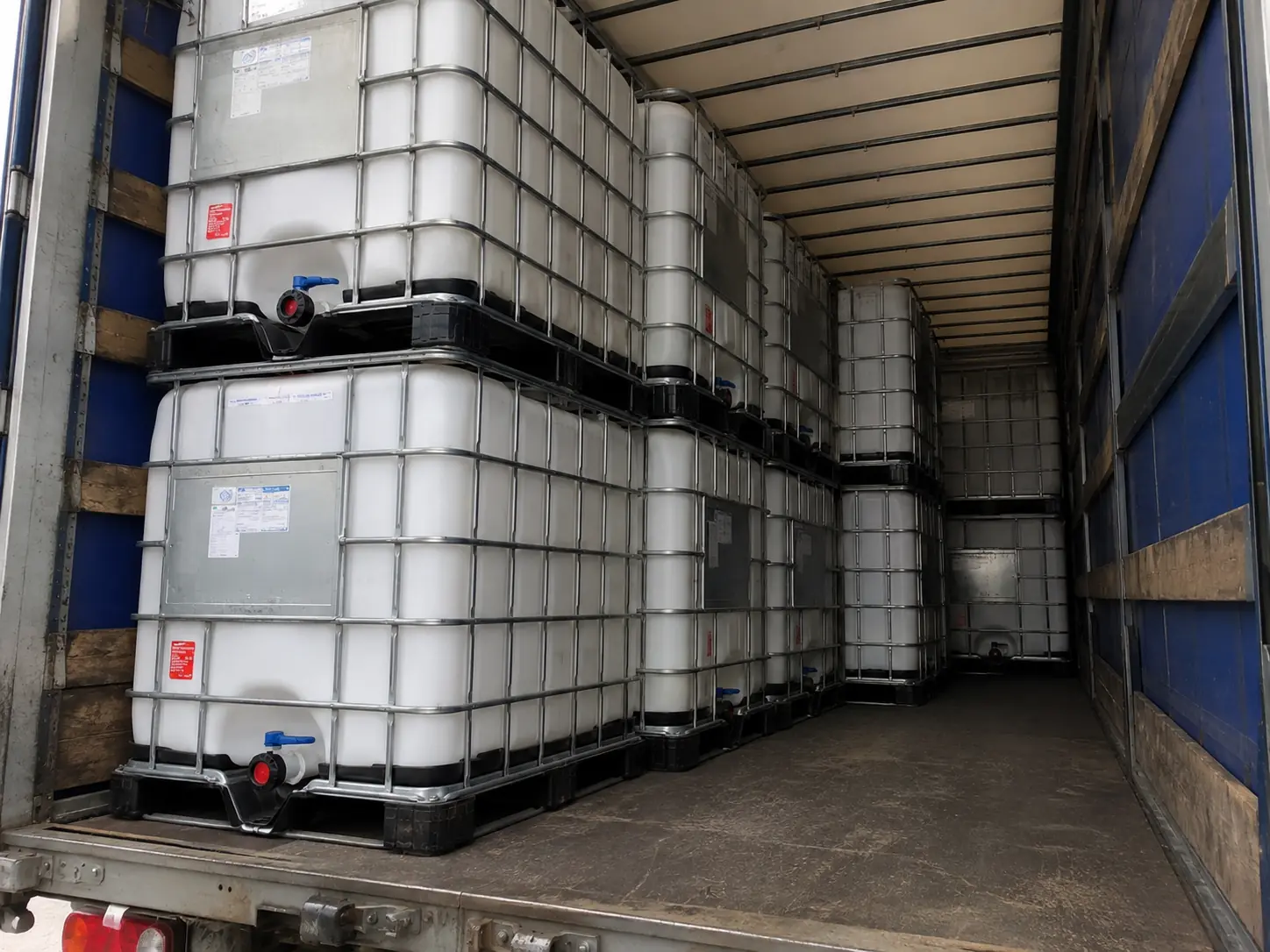
Every container is photographed, its plate read and its prior-contents declaration matched before it moves another metre. Anything undeclared goes to the quarantine corner, not into the queue. This is where roughly seven in ten containers are marked for reuse and the rest are routed to parts or granulation.
Pre-rinse and heel capture
Heels are drained into characterised collection rather than flushed. It is the least interesting part of the yard and the part that most clearly separates a permitted operation from one that will eventually be in the news.
Wash bays one and two
Rotating spray heads on a timed cycle, caustic for resins and dried polymers, hot detergent for oils and general industrial residue. A hose through the lid never touches the top third of a bottle, which is why home-cleaned totes almost always fail our inspection.
The food line
Physically separate. Different bay, different spray heads, different chemistry, and no solvent work has ever run through it. Final rinse is tested for total organic carbon and has to come back below 5 ppm before a unit moves on. Cross-contamination is invisible, so the only defensible control is separation.
Drying and inspection
Hot-air dry under filtered air, then the bench: wall thickness at four points, weld integrity, foot squareness, collar and outlet threads, and cage geometry against a jig. A container that fails the jig goes to the steel mill rather than back onto a truck.
Rebottling bench
Where reclaimed cages are straightened, re-welded and paired with new bottles. Each build is recorded so we know which cage received which bottle — which matters when a unit comes back to us in five years.
Test and marking
Leakproofness at 20 kPa, recorded against the serial number rather than the batch. Fresh UN plate where the design type allows, wash certificate printed, interior photographed.
The fabrication corner
Where Grade C containers become rain harvesters, raised beds, aquaponics sumps and wash stations. It started with one request from a community garden in 2021 and never stopped.
Visiting
Come during opening hours and ask for the yard office. Bring a torch if you have one — we would far rather you inspected the stock than took our word for it. Full address, hours and directions are on the contact page.
- Monday – Friday: 7:00 AM – 5:00 PM
- Saturday: 8:00 AM – 1:00 PM
- Sunday: Closed
Why the food line is a separate room
It would have been cheaper to run food work as a scheduled slot on the same equipment — a deep clean between cycles, a documented changeover, the sort of control most yards our size operate. We did not do that, for a reason worth stating plainly: cross-contamination in a wash line is invisible and untraceable. You cannot inspect for it, the customer cannot detect it, and if it ever happened nobody would find out until the product downstream was already sold.
A control you cannot verify is not a control. Physical separation is the only version of this that survives contact with a bad week, so we built the room.
Quarantine, and why it is deliberately inconvenient
The quarantine corner sits between intake and the wash bays, in everyone's way. That is intentional. A container with an undeclared history is the one genuine hazard in this business — to our staff, to our line, and to whoever eventually buys the unit two owners downstream. Making it awkward to ignore is a cheaper safety system than any amount of training.
What we cannot do here
We are not a hazardous waste treatment facility. We capture and characterise heels and send them to a permitted treatment operation; we do not treat them ourselves. We also do not take containers with product still in them. If you have full or partially full containers, that is a different job with a different permit and we will point you at someone who holds it.
Can I visit the yard and inspect stock?
Yes, six days a week at 19-22 45th St, Astoria, NY 11105. For orders over twenty units we genuinely prefer that you come and inspect before committing — open the lids, put a torch inside and read the plates yourself.
Do you have a separate wash line for food-grade containers?
We do. There are two general wash bays plus a dedicated food line, so food-grade work never shares equipment with chemical work. Units are sealed immediately off that line rather than left open in the yard.
Can you rebottle on site?
Yes — the rebottling bench is part of the facility. A virgin HDPE bottle goes into the re-certified cage, which keeps 42 kg of steel in service and gives you a fresh UN 31HA1 mark.
Will you take containers that still have product in them?
No. We are not a hazardous waste treatment facility. We capture and characterise heels and send them to a permitted treatment operation, but full or partially full containers are a different job under a different permit.
Can I drop totes off myself rather than booking a collection?
Yes. Email us before you set off so we can clear a bay, and bring the prior-contents declaration — we cannot take undeclared containers off a truck, however clean they look.
Come and open some lids.
Six days a week in Astoria. For orders over twenty units we genuinely prefer that you inspect before committing.