Knowledge · Reference
Every term you'll meet on a tote spec sheet.
Term we haven't defined?
Replies within one business day · Fields marked * are required
Bottle
The inner HDPE receptacle of a composite IBC. Blow-moulded in one piece, typically 17 kg on a 275-gallon unit. It is the part that ages: UV, permeation and stress cracking all attack the bottle long before they trouble the cage.
See also: Cage, Rebottling
Buttress thread
The coarse, asymmetric thread used on IBC outlets and lids — S60x6 and S70x6 are the common sizes. Designed to seal under load without galling, which is why your NPT adapter won't thread on without a proper coupler.
Cage
The welded galvanised steel lattice that gives a composite IBC its structure and stacking strength. About 42 kg on a 275. Steel is close to infinitely reusable, which is why we salvage cages even from totes with ruined bottles.
See also: Bottle, Rebottling
Certificate of Destruction
A numbered document confirming specific serialised containers were destroyed and removed from circulation. Required after recalls, brand-protection clearances, or where residue history makes reuse indefensible.
Composite IBC
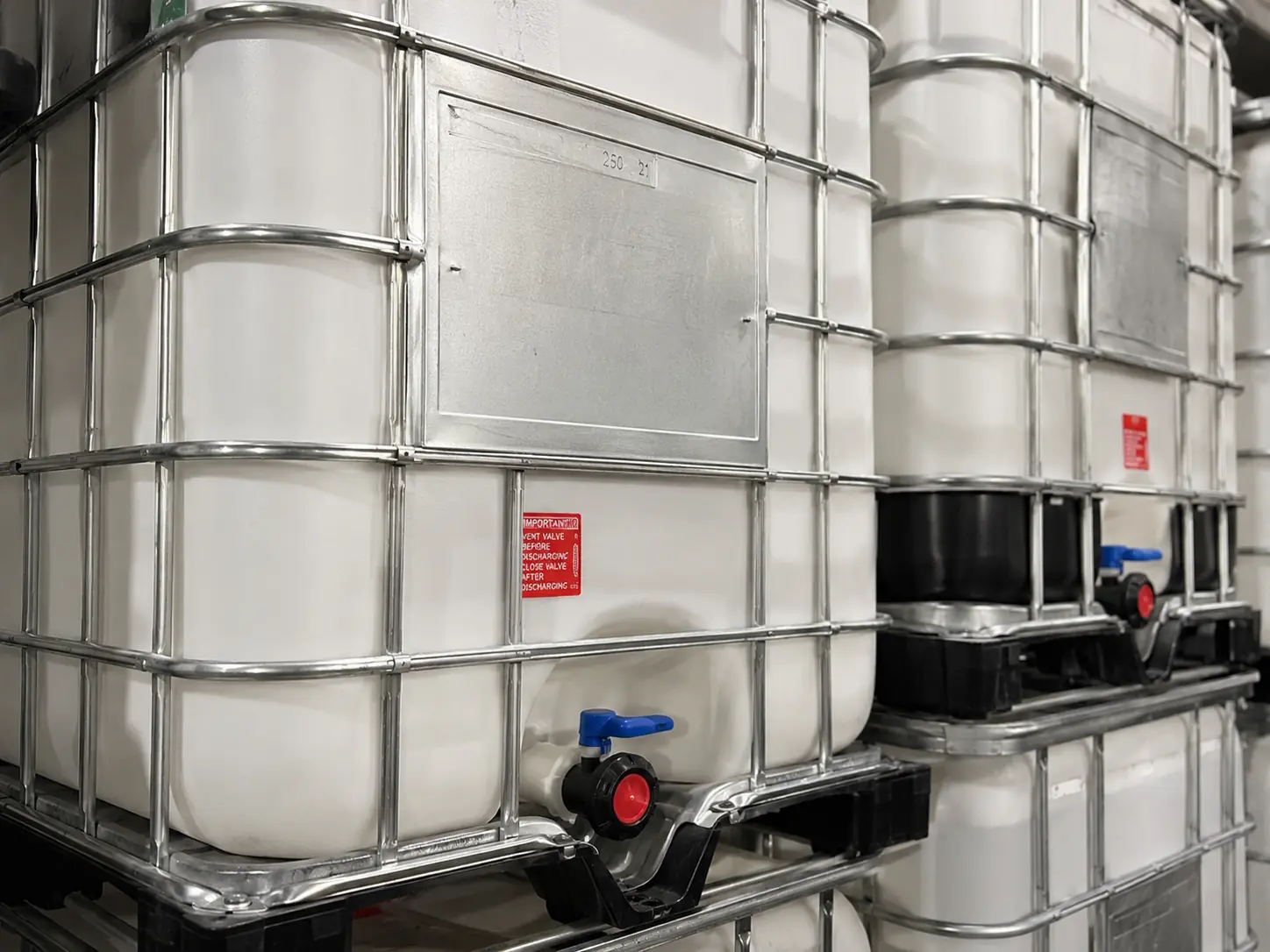
A container built from a rigid plastics inner receptacle inside an outer casing of another material — in practice, an HDPE bottle in a steel cage. Design code 31HA1. Roughly nine out of ten totes in circulation.
Design type
The tested and approved configuration a container was built to, expressed as the UN code (31HA1, 31H1 and so on). Change the wall thickness, the cage gauge or the closure and you have a different design type needing its own approval.
Food grade
Not a property of the plastic alone. It requires virgin food-contact HDPE, a documented food-only prior history, and cleaning on a line that never handles industrial chemistry. Absent any one of the three, the term is marketing.
See also: Prior contents declaration
Gross mass
Container plus contents plus every fitting. The maximum permitted gross mass appears as the last number in the UN marking. Subtract the tare to find your real payload.
See also: Tare
Heel
The residue left in a 'empty' container — usually a few litres. Legally it is still the product, with the product's hazard classification. Capturing and characterising heels properly is most of what separates a compliant yard from a fly-tipping operation.
Leakproofness test
A pressure hold, normally 20 kPa, confirming a container and its closures do not leak. Required on composite IBCs every 2.5 years in dangerous-goods service under 49 CFR 180.352, and performed on every unit that leaves our line regardless.
Packing group
The danger tier a container is approved for, marked X (groups I, II and III), Y (II and III) or Z (III only). Y is the normal marking on a caged tote.
Permeation
The slow migration of a substance into and through the wall of the HDPE bottle. It is why a tote that has held a solvent can never be made food grade: the chemistry is in the plastic, not on it, and it leaches back out for years.
Prior contents declaration
A written statement from the last filler naming exactly what a container held. The single most important document in the used-tote trade, and the one thing we will not proceed without.
Rebottling
Fitting a brand-new HDPE bottle into a reclaimed, inspected and re-certified cage. Gives you virgin-bottle purity and a fresh UN mark while keeping the steel in service — the best environmental result available when a new bottle is genuinely required.
See also: Reconditioning
Reconditioning
Returning a used container to service with its original bottle: wash, inspect, replace hardware, test, re-mark. Distinct from rebottling and from simple washing.
See also: Rebottling
Regrind
Granulated post-use HDPE. Tote bottles produce a clean, high-value regrind when they are properly rinsed and kept separate from mixed plastics — which is why we never granulate a dirty bottle.
Rinsate
The liquid produced by washing a container. It carries the hazard profile of whatever it rinsed and goes to a permitted treatment facility, never to drain.
Specific gravity (SG)
Density relative to water. It is the number that decides whether your product fits a tote: at 1.83 SG, a full 275 of sulphuric acid weighs about 4,330 lb and blows straight past a 2,650 lb gross-mass marking.
Stacking test load
The mass a container was tested carrying on top of it. Divide by the gross mass of one filled unit, subtract the one on the floor, and you have your legal stack height. A marked value of 0 means nothing stacks on it in transport.
Tare
Empty weight. About 130 lb for a 275-gallon composite tote on a steel pallet, 148 lb for a 330.
See also: Gross mass
Tote
North American shorthand for an intermediate bulk container. Everywhere else it is an IBC. Both mean the same cube of liquid on a pallet.
UN marking
The stamped or plated code certifying a container's tested design type, packing group, manufacture date, approving state, stacking load and maximum gross mass. Our decoder reads all of it back in plain English.
See also: Design type, Packing group
Terms specific to the UN marking — design type, packing group, stacking test load — are covered field by field on the decoder page.
What does IBC actually stand for?
Intermediate bulk container — intermediate because it sits between a drum and a bulk tanker. In this trade it almost always means a 275 or 330 gallon composite unit: an HDPE bottle in a galvanised steel cage on a pallet base.
What is a heel?
The residue left in a container after it has been emptied as far as gravity will take it. Heels are why a prior-contents declaration matters: the container carries the hazard profile of whatever is still clinging to the inside of the bottle.
What is the difference between tare and gross mass?
Tare is the empty weight of the container itself, typically around 62 kg for a caged 275. Maximum gross mass is the heaviest the whole thing may be when filled, and both figures are stamped on the UN plate.
What does a stacking test load of zero mean?
That nothing may be placed on top of that container in transport. It is not an omission or a typo — it is a specific rating, and it is the single field on the plate people most often misread.
Heard a term that is not defined here?
Send it over and we will add it. Half this page exists because a customer asked what something on one of our quotes meant, which is usually a sign the quote could have been clearer.
Keep reading
Heard a term we haven't defined?
Send it over and we'll add it. Half this page exists because a customer asked what something on a quote meant.