Sizes & specs · Free tool
Read the stamp on any tote.
Send us a photo of your plate
Replies within one business day · Fields marked * are required
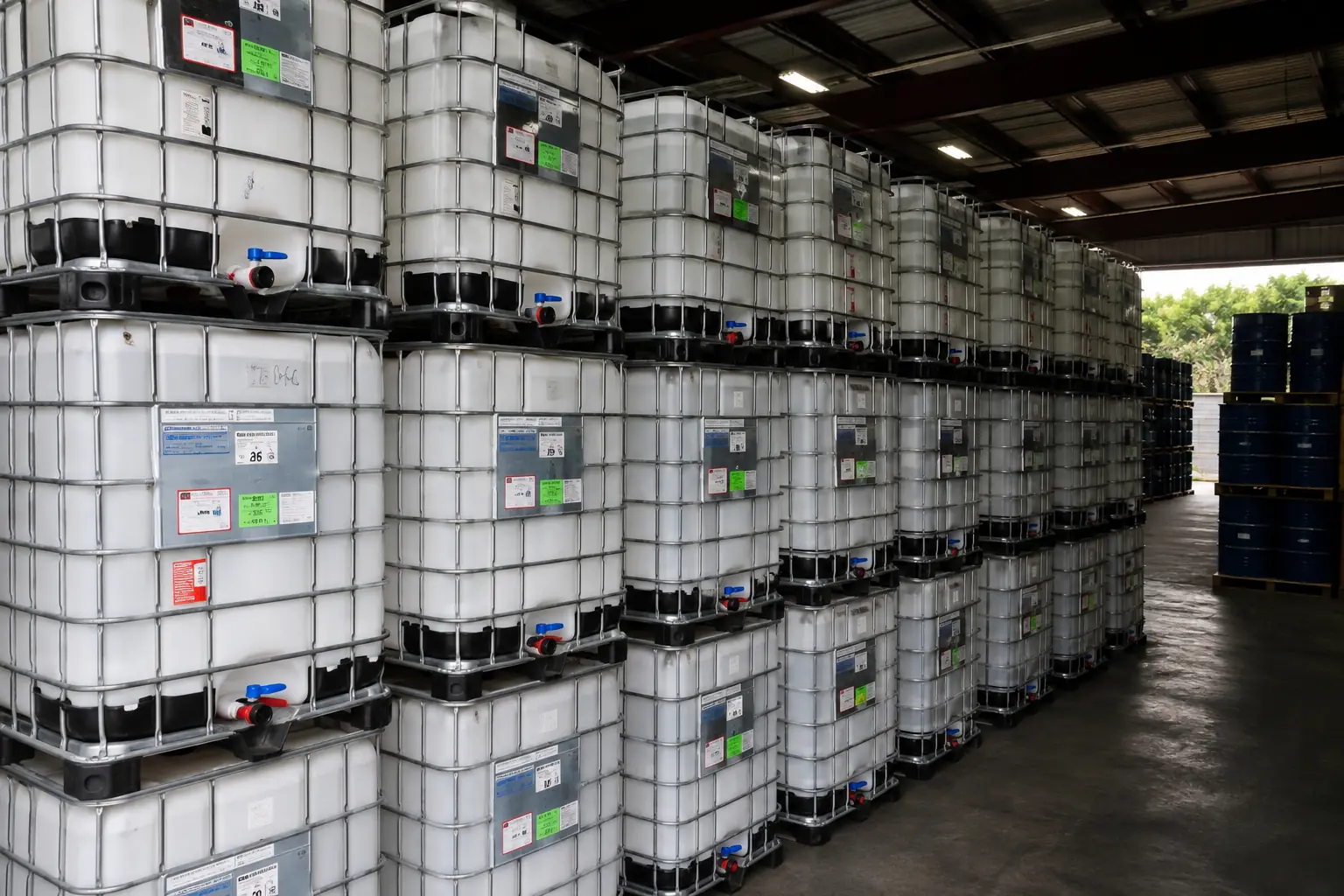
Standard caged composite IBC — the tote we buy, wash and reissue every day.
Field by field
What each block of the marking is telling you.
The order is fixed by UN Model Regulations chapter 6.5, mirrored in 49 CFR 178.703 and ADR 6.5.2. Once you know the order, you can read any container in the world.
| Position | Example | What it is | Why you care |
|---|---|---|---|
| 1 | UN symbol | Packaging symbol | Confirms this is a UN-certified container at all, not just a box |
| 2 | 31HA1 | Design type code | Container category, materials and construction — the core of the marking |
| 3 | Y | Packing group | Which danger tiers it may legally carry |
| 4 | 0324 | Month and year of manufacture | Drives the retest clock — 2.5 years for leakproofness, 5 for periodic |
| 5 | USA | Authorising state | Whose competent authority approved the design |
| 6 | M5876 | Manufacturer / approval reference | Traces back to the original test report |
| 7 | 2500 / 1450 | Stacking load, then max gross mass (kg) | Your legal stack height and your real payload |
| Code | Meaning | Where you see it |
|---|---|---|
| 31HA1 | Rigid IBC for liquids · plastics inner in a steel outer · rigid inner | The standard caged tote. Nine out of ten containers in circulation |
| 31H1 | Rigid plastics IBC for liquids · structural equipment takes stacking load | Freestanding poly IBCs with an integrated frame |
| 31H2 | Rigid plastics IBC for liquids · freestanding | Uncaged poly tanks. Often marked with zero stacking load |
| 31HZ2 | Composite for liquids · flexible inner receptacle | Rare — bag-in-cage constructions |
| 11G | Rigid IBC for solids · fibreboard · gravity filled | Powder and granule containers, not liquid totes |
| 11A | Rigid IBC for solids · steel · gravity filled | Metal bins for solids |
| 21A | Rigid IBC for solids · steel · pressure filled | Pneumatically filled steel bins |
| Letter | Material |
|---|---|
| A | Steel |
| B | Aluminium |
| C | Natural wood |
| D | Plywood |
| F | Reconstituted wood |
| G | Fibreboard |
| H | Plastics |
| L | Textile |
| M | Paper, multiwall |
| N | Metal other than steel or aluminium |
Three things the marking will not tell you
The plate is authoritative about the design type and useless about the container's actual condition. Do not confuse the two.
- What was in it. Nothing on the plate records prior contents. That comes from the declaration and the physical evidence, and it is the single most important thing to establish before buying.
- Whether the retests are current. The manufacture date starts the clock; the retest plate records whether anyone has kept it wound. A 2019 tote with no retest markings is not authorised for regulated product no matter how good the original stamp looks.
- Whether the bottle is sound. Permeation, stress cracking and UV degradation are invisible to a plate. Put a torch inside.
Reading the stacking figure properly
Divide the stacking test load by the gross mass of one filled container, then subtract one for the unit standing on the floor. A plate reading 2,500 kg with filled units at 1,200 kg gives (2,500 ÷ 1,200) − 1 = 1.08, so two high. Round down, always, and remember the test was conducted on a new container on a flat surface — not on a five-year-old cage on an uneven yard.
If the plate is missing
A container without a legible plate cannot carry dangerous goods, full stop. It is still perfectly good for non-regulated on-site use, which is precisely why our Grade B and C categories exist. If you need the container back in regulated service, the route is rebottling, where a new bottle in a re-certified cage earns a fresh marking.
What does UN 31HA1 mean?
31 means a rigid IBC intended for liquids. H means the inner receptacle is plastics. A means the outer casing is steel. The trailing 1 means the inner receptacle is rigid. Together it describes the standard caged composite tote: an HDPE bottle inside a welded galvanised steel cage.
Where is the marking on an IBC tote?
Usually on a stainless or aluminium plate riveted or wired to the cage on one of the long sides, near the top. Some manufacturers also emboss the design code into the bottle's top collar. On rebottled units the plate is reissued by the reconditioner.
Does a UN marking expire?
The design-type marking itself does not, but the container's authorisation to carry dangerous goods depends on current test dates. Under 49 CFR 180.352 a composite IBC needs a leakproofness test every 2.5 years and a full periodic inspection every 5 years. Look for the retest plate, not just the original stamp.
What does X, Y or Z mean on a tote?
The packing group approval. X covers Packing Groups I, II and III. Y covers II and III. Z covers III only. Y is the normal marking on a caged composite tote and covers most solvents, acids, resins and cleaning chemistry.
What if the stacking test load says 0?
Nothing may be stacked on that container in transport. It is a hard rule rather than a recommendation, and it appears mostly on freestanding plastic IBCs that carry their stacking load in the body rather than a cage.
Plate corroded, cropped or half-unreadable?
Send us the photo. Between the legible fragments, the cage construction and the bottle geometry we can usually reconstruct the whole marking.