Comparison
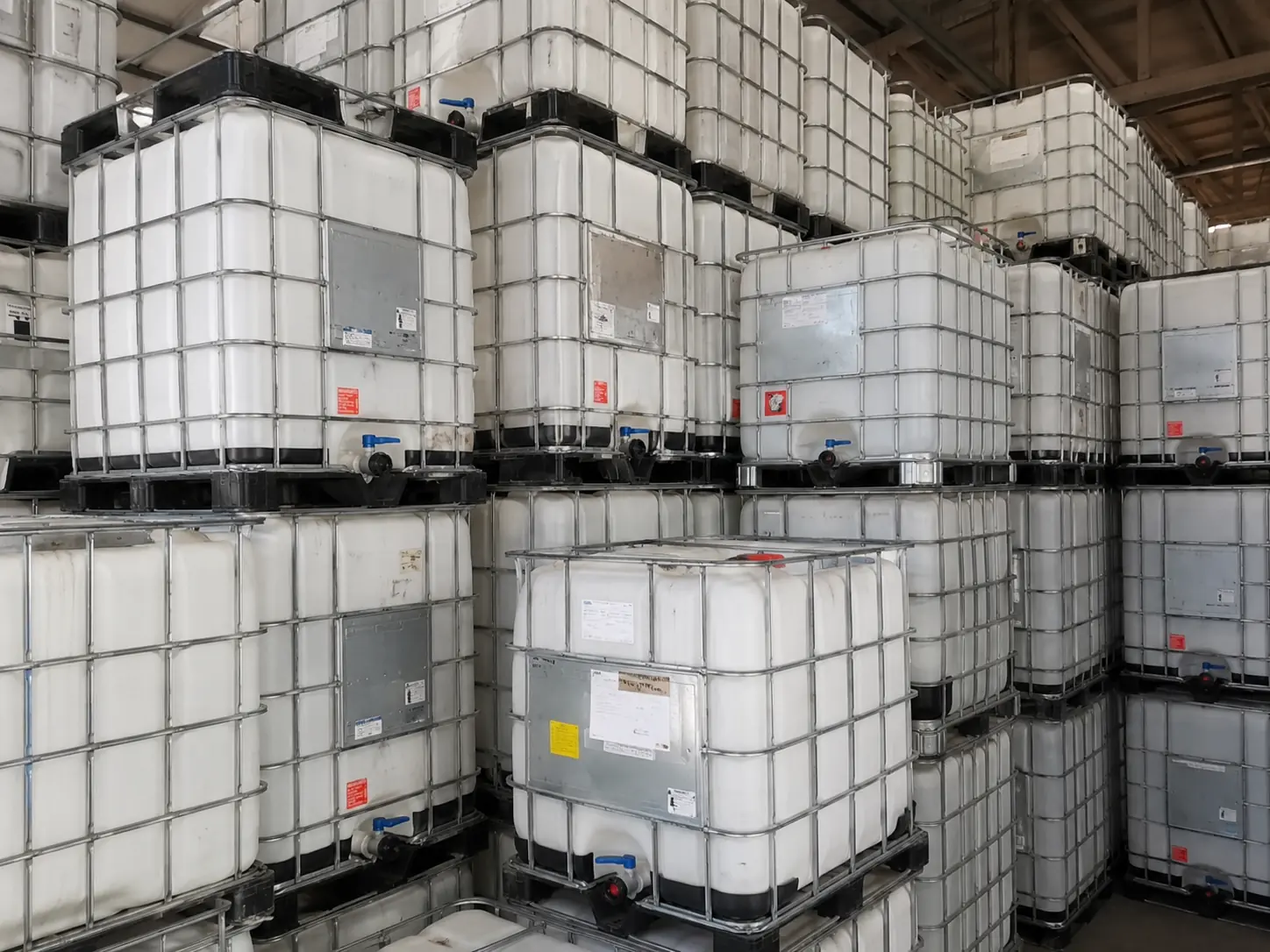
Caged vs uncaged: when the steel earns its keep.
Not sure which one? Ask.
Replies within one business day · Fields marked * are required
| Caged composite (31HA1) | Uncaged poly (31H2 / tank) | |
|---|---|---|
| Typical tare, 275 gal | ~130 lb | ~65 lb |
| Stacking | Two to three high loaded, per plate | Often not stackable at all |
| Impact protection | Cage takes the hit | Body takes the hit |
| Forklift handling | Four-way pallet base | Skid or none — check first |
| Repairability | Rebottle, keep the steel | One-piece — failure is scrap |
| Used availability | Abundant, from $95 | Scarce, rarely under $300 |
| Shapes available | Cube, one footprint | Cone-bottom, vertical, horizontal |
| Chemical range | HDPE | HDPE or cross-linked (XLPE) |
| Best for | Transport, storage, reuse cycles | Static tanks, odd geometry, aggressive chemistry |
What the cage is actually doing
Three jobs, and only one of them is obvious. It carries the stacking load so the bottle does not have to, which is why a composite tote can go two or three high loaded while most freestanding tanks cannot go at all. It takes impacts — a forklift tine that would hole a bare bottle bounces off a cage member. And it provides the four-way pallet base that lets any warehouse in the world move the thing without thinking about it.
The reuse argument, which nobody makes
Here is the case that decides it for us. A caged tote is two components with wildly different lifespans: a consumable bottle and a near-permanent steel frame. When the bottle is finished you replace it and the frame carries on. A one-piece poly tank has no such split — when it fails, all of it fails, and the entire object becomes regrind at best.
That single design decision is why composite totes dominate the reuse market and why our whole business is built around them. Repairability is an environmental property, not just a commercial one.
When to go uncaged anyway
- Cone-bottom drainage. If you need every last litre out without tipping, a cube will never do it.
- Cross-linked polyethylene. XLPE handles chemistry and temperature that blow-moulded HDPE cannot. It is also, notably, essentially unrecyclable — a real trade-off, not a free upgrade.
- Weight-critical installations. Roof tanks, mezzanines, anywhere the 42 kg of steel is genuinely a structural problem.
- Non-standard footprints. Where a 48 × 40 cube simply does not fit the space you have.
Can I stack an uncaged tank?
Only if the plate says so. A freestanding 31H2 design carries its own stacking load in the body, and many are rated for it — but plenty are marked with a stacking test load of 0, which means nothing goes on top in transport, full stop.
Which is cheaper to buy used?
Caged, by a wide margin, purely because there are vastly more of them in circulation. A used 275-gallon composite tote starts around $95; a comparable uncaged poly tank is a specialty item and rarely appears below $300.
Which is better environmentally?
Caged, for one unglamorous reason: repairability. When a bottle fails you rebottle it and keep 42 kg of steel in service. When a one-piece poly tank fails, the whole object is scrap.
Describe the installation.
Where it sits, what goes in it, whether it moves, and what the drainage has to do. We'll tell you which container the job actually wants.