Knowledge · Pillar guide
How to buy an IBC tote without overspending.
Get a quote while you read
Replies within one business day · Fields marked * are required
The framework
In this order, because each one narrows the next.
People usually start with price, which is why they end up with the wrong container at a good price. Start with the journey the container makes.
- 01
Capacity
275 unless you have a reason. If your product is at or below the density of water and you have measured every clear height between the truck and the final position, the 330 gives you 20% more for the same floor space and freight.
- 02
Grade
Work backwards from the journey, not the budget. Regulated transport needs Grade A or rebottled. Food contact needs documented food-only history. On-site water storage needs Grade C and nothing more.
- 03
Certification
Does anything downstream need a valid UN mark with current retest dates? If yes, that constraint outranks every other consideration and rules out most of the cheap stock.
- 04
Fittings
Valve type, outlet thread and gasket chemistry. Getting the gasket wrong is a slow leak nobody notices for a month. Check compatibility against your actual product, not its family.
- 05
Pallet base
Steel for durability and resale, composite for food and export, wood only if it stays dry and domestic. This is the decision people skip and regret in year three.
- 06
Supplier
Ask for three things before committing to volume: the prior-contents declaration, the leak test record keyed to the serial, and an interior photograph. A yard that cannot produce all three is guessing, not grading.
Decision one: capacity
The default is the 275-gallon unit at 48 × 40 × 46 inches, because it is built on the pallet footprint North American logistics is designed around. The only real alternative worth considering is the 330, which shares the exact footprint and adds seven inches of height for 55 more gallons.
Three things kill the 330: racking set at 54 inches of clear bay, older freight lifts (a real problem in Manhattan and Brooklyn), and product denser than water — a full 330 of water already sits at 2,902 lb against a typical 3,000 lb marking. Measure the tightest clear height on the whole route before you order a trailer load. Everything else is on the size guide.
Decision two: grade
The single biggest lever on price, and the one most often got wrong in both directions. Full definitions are on grades explained; the short version:
- Grade C, ~$95. Static, non-transport, water and upcycling.
- Grade B, $130–$180. Sound and tested, visibly used. Most on-site work.
- Grade A industrial, $190–$240. Presentable, documented industrial history.
- Grade A food-grade, $240–$285. Food-only history, TOC verified.
- Rebottled, $240–$395. New bottle, reclaimed cage, fresh mark.
- New, $385–$620. When a specification genuinely demands it.
Decision three: certification
This is a yes/no gate, not a preference. If regulated product moves on a public road in that container, it needs a legible UN marking and current retest dates — leakproofness every 2.5 years, full periodic inspection every 5, under 49 CFR 180.352. An original 2019 stamp with no retest plate does not qualify. Learn to read the marking on the decoder page; it takes about two minutes and it will save you from a bad purchase eventually.
Decision four: fittings
Outlets are almost always a 2-inch butterfly valve on an S60x6 or S70x6 buttress thread. They are not NPT, and no quantity of PTFE tape will change that — you need the correct adapter, which costs a few dollars.
Gasket chemistry is the one that quietly costs money. EPDM handles water, acids, bases and aqueous chemistry. Viton handles aromatics, hydrocarbons, chlorinated solvents and oils. Fitting the wrong one produces a weep rather than a failure, so nobody notices until there is a stain spreading across the warehouse floor. Check your specific product against a compatibility chart, not its general family.
Decision five: pallet base
Steel is the default: most durable, best resale, heaviest. Composite is lighter, cannot rot, and sits outside ISPM 15 heat-treatment rules — the right answer for food and export. Wood is cheapest and absorbs every spill that lands on it, which is a contamination problem you cannot clean. Full comparison on pallet types.
Decision six: supplier
Grading is not standardised, so the grade name on the invoice is worth exactly as much as the evidence behind it. Before you commit to volume, ask for:
- The prior-contents declaration from the original filler.
- The leakproofness test record, keyed to that container's serial number rather than to a batch.
- A photograph of the interior, taken with a flash.
And if you are buying more than twenty units, go and look at them. Any yard that discourages an inspection is telling you something.
What things cost
Real New York numbers, not national averages.
Prices move with the scrap steel index and with how much the local chemical and food trade released that month. These are the bands we quote inside.
| Option | 275 gal | 330 gal | Transport-legal | Food contact | Best for |
|---|---|---|---|---|---|
| Grade C | $95 | $130 | No | No | Static water, ballast, upcycling |
| Grade B | $130–$180 | $165–$220 | Non-regulated | No | General on-site liquid work |
| Grade A industrial | $190–$240 | $225–$285 | Yes* | No | Solvents, coatings, ag chemistry |
| Grade A food-grade | $240–$285 | $280–$340 | Yes* | Yes | Food, beverage, cosmetic, potable |
| Rebottled | $240–$395 | $290–$450 | Yes | Yes | Virgin bottle with a fresh mark |
| New | $385–$620 | $440–$700 | Yes | Yes | Validated or contractual requirements |
* Subject to current retest dates. An intact original stamp is not the same as an in-date container.
What does a used IBC tote actually cost in New York?
A Grade C 275-gallon unit fit only for static water storage starts around $95. A Grade B general-purpose tote runs $130–$180. A cosmetically clean Grade A industrial unit is $190–$240, and a documented food-grade A is $240–$285. Rebottled units — new bottle, reclaimed cage — sit at $240–$395. New is $385–$620. Prices move with the scrap steel index and with how many totes the local chemical trade has released that month.
How do I know which grade I need?
Work backwards from the contents and the journey. If the product is regulated for transport, you need a valid UN marking and therefore a Grade A or rebottled unit. If it is food or cosmetic, you need documented food-only prior contents. If it never leaves your site and holds water, Grade B or C is genuinely fine and anything more is wasted money. Most people over-specify; we will tell you when you are.
Can I inspect totes before buying?
Yes, and for orders over twenty units we encourage it. Come to the Astoria yard during opening hours, open the lids, put a torch inside, check the plates. We would far rather you looked than sent them back.
Do you deliver, and how many fit on a truck?
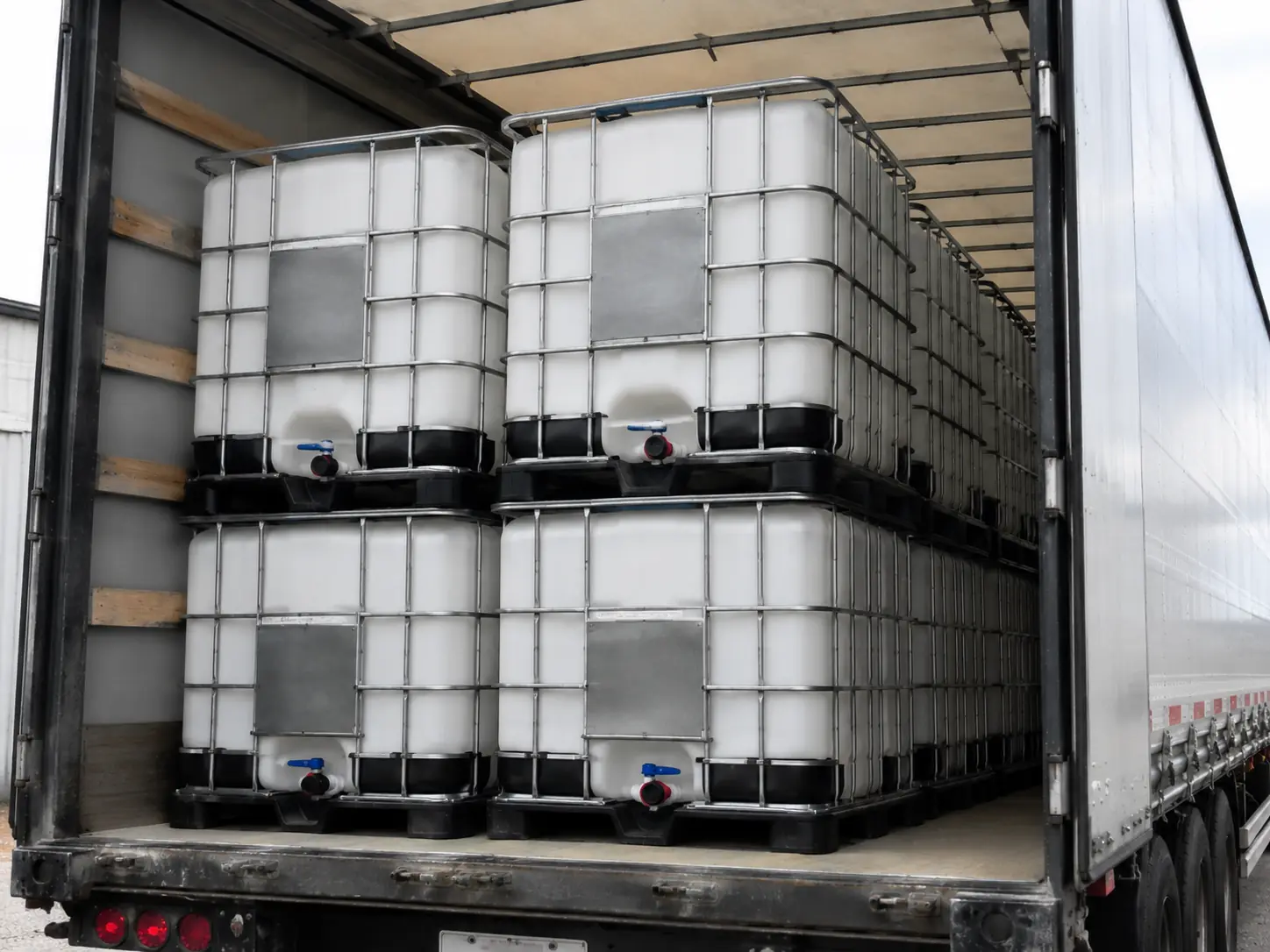
Forty 275- or 330-gallon totes fit on a standard 53-foot trailer, single-stacked. We deliver across the five boroughs within the week, and Long Island, Westchester and northern New Jersey in two to four days. Small orders can be collected from the yard.
Worked through the six? Get a quote.
Tell us what you concluded and we'll confirm it — or tell you honestly where the cheaper option would have done.