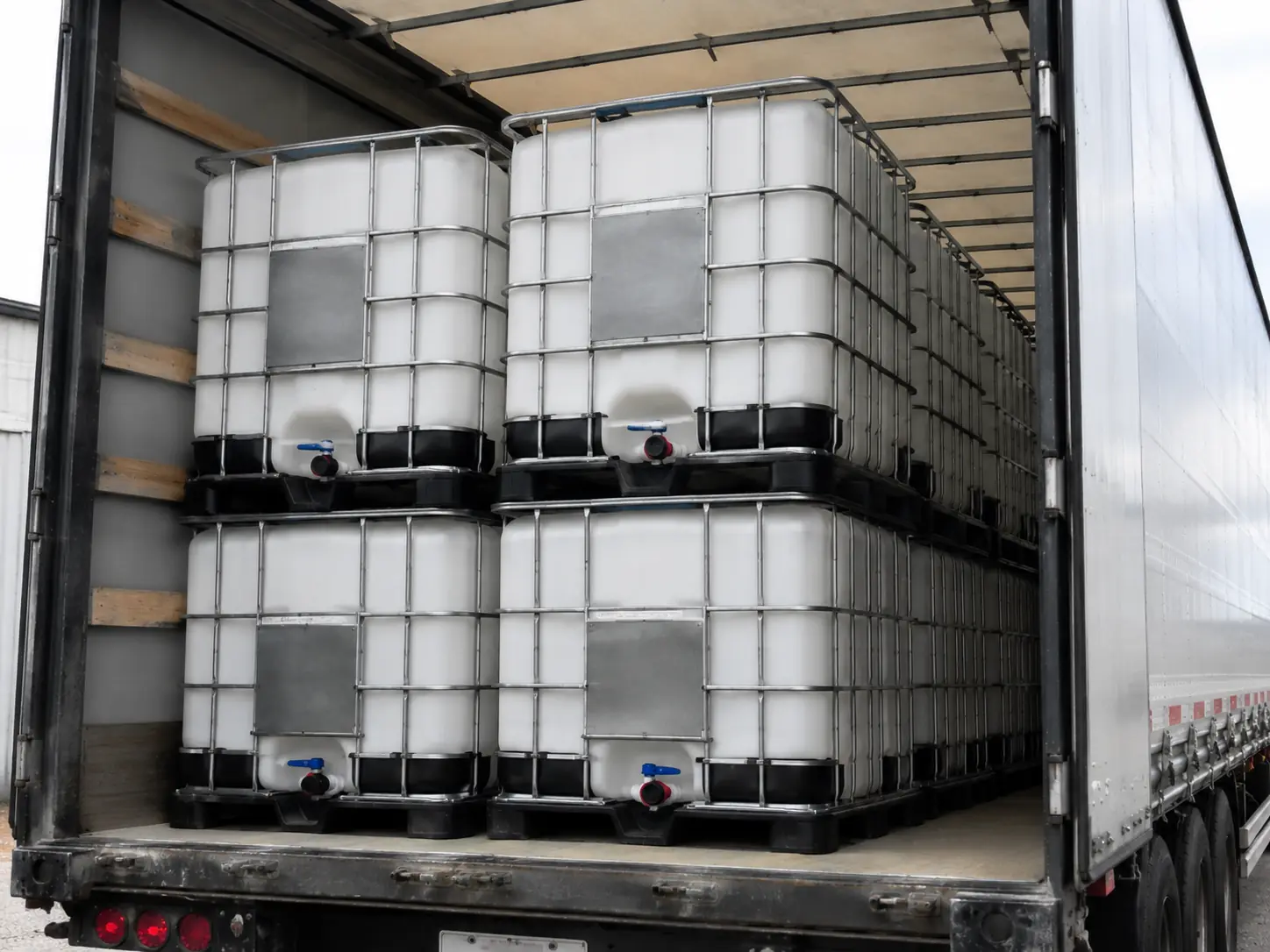
Of the containers we grade down or scrap on arrival, handling damage is second only to UV degradation. Almost all of it comes from four situations, and all four are training problems rather than equipment problems.
The tine strike
A driver approaching at a slight angle catches the leading edge of a tine on the cage rather than entering the pallet aperture cleanly. On a steel-base tote this bends a cage member; on a composite base it splits the pallet skirt.
The damage looks cosmetic and frequently is not. A bent lower cage member no longer supports the bottle evenly, so when the container is filled the bottle deforms into the gap and develops a stress concentration exactly where you cannot see it. That container will weep in about eight months.
Fix: approach square, every time, and slow down inside the last metre. Every yard knows this and every yard has a driver who does not do it.
Lifting a full tote by the top rail
We see this on containers that arrive with the top cage frame visibly distorted. Somebody has slung it or lifted it from the top rail rather than from the pallet base.
The top frame is a structural tie, not a lifting point. It is not rated to carry 1,200 kg of filled container and it will not tell you it has been overloaded until the stack it is supporting comes down.
The one thing worth putting on a laminated sign
Full containers are lifted from the pallet base with the tines fully engaged, square, and nothing else. If you need to move a full tote and cannot get tines under it, the answer is to pump the product out, not to get creative.
Stacking to the plate rather than to the yard
The stacking test load on the UN plate is a laboratory figure: a new container, on a flat surface, at controlled temperature, for a defined period. It is a legitimate number and it is not a licence.
A five-year-old cage on an uneven yard in August is not a laboratory. We take the plate figure, divide by filled gross mass, subtract one for the unit on the floor, and then subtract one more if the containers are over three years old or the surface is not dead flat. That last step is judgement rather than regulation, and it is why we have never had a stack come down.
The corner post nobody looks at
Cage damage concentrates at the four corner posts because that is what everything hits — door frames, racking uprights, other totes, walls. A container with one bowed corner post is out of square, which means it does not sit flat, which means the next one stacked on it is loading three feet instead of four.
Check it with a straight edge or just by eye down the length of the post. It takes two seconds per container and it is the check most yards skip.
What it costs
A tine strike that bends a lower cage member drops a Grade A container to Grade B: about $60 off the resale value, and considerably more off its remaining service life. A distorted top frame usually means we buy it as a rebottling donor at scrap rates — call it $150 of value gone.
Against that, a slow, square approach costs about four seconds per movement. We have watched yards halve their damage rate by doing nothing except telling drivers the containers are worth money, which is information nobody had bothered to give them.
If damage has already happened
Do not scrap it and do not write it off. A bent cage on a sound bottle is usually straightenable on our jig, and a sound cage under a ruined bottle is a rebottling candidate worth real money. We buy damaged containers precisely because most of the value in a composite tote survives the kind of accident that makes people give up on it.
Danny Foulkes is the yard manager at IBC Tote Recycling NY in Astoria, Queens. We publish the figures we work from — if you think one of them is wrong, tell us.