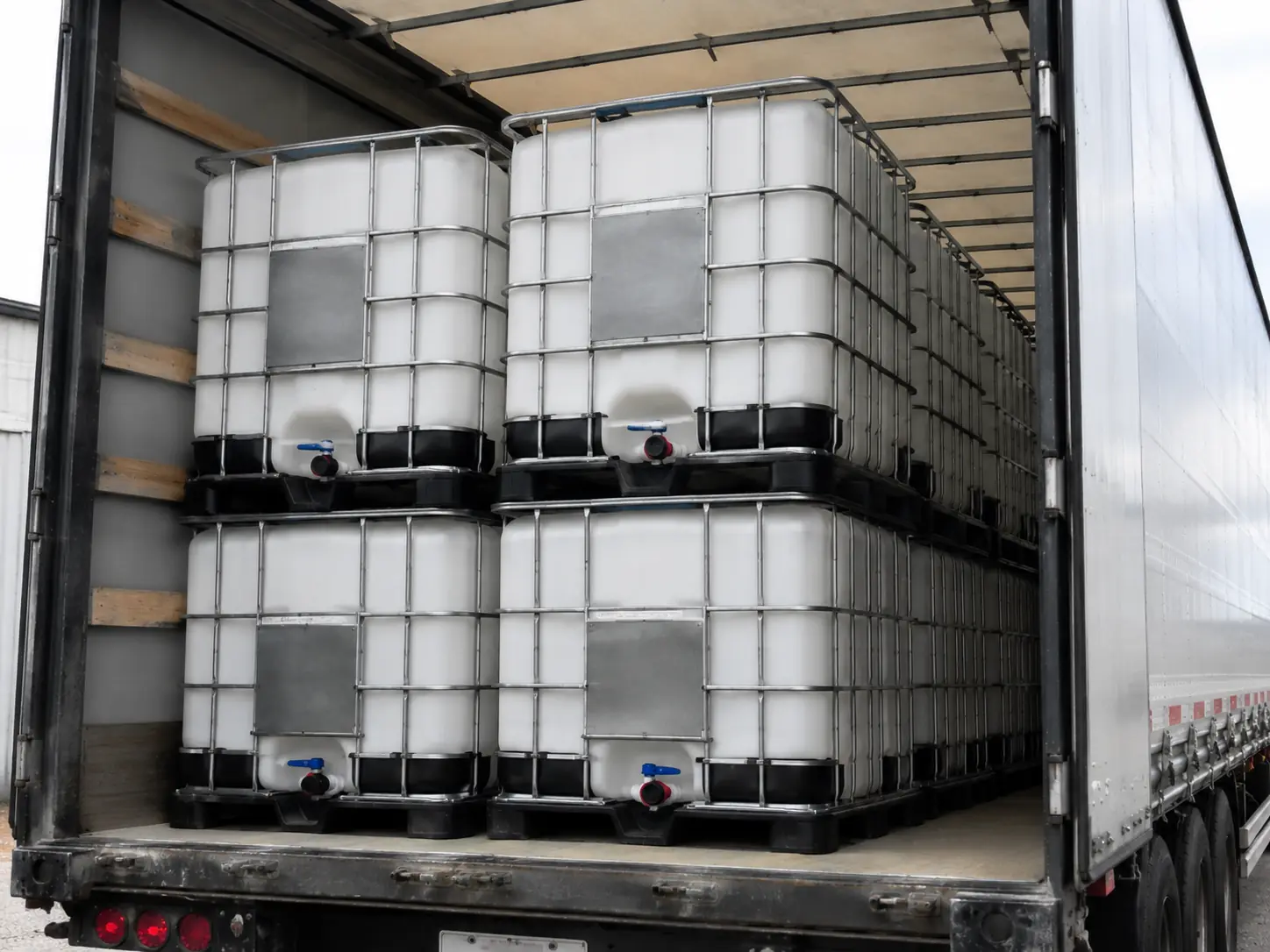
The stacking test load is printed on every UN plate and misread more often than any other field on it. It is not a stack height. It is a mass, in kilograms, and turning it into a stack height takes one division and three judgement calls.
The calculation
Legal stack height = (stacking test load ÷ gross mass of one filled container) − 1.
The minus one is for the container standing on the floor, which carries the load rather than contributing to it. People forget it constantly and end up one tote too high.
A worked example. Plate reads 2,500 kg stacking test load, 1,250 kg maximum gross mass. Your containers are filled with water at about 1,100 kg gross. So: 2,500 ÷ 1,100 = 2.27, minus one = 1.27. Round down. You may put one container on top of another. Two high, total.
Note how far that is from the intuition that a 2,500 kg rating means you can put two 1,250 kg containers on top.
What the test actually was
Under UN Model Regulations 6.5.6.6, a composite IBC is loaded with the calculated superimposed mass and held — for plastics, 24 hours at 40°C, precisely because HDPE creeps under sustained load at temperature.
The conditions are important: a new container, at a controlled temperature, on a flat rigid surface, undisturbed. That is a laboratory. Your yard is not one.
The three adjustments nobody makes
- Age. A cage that has been racked, dropped and re-squared several times does not carry load the way the tested one did. Over three years, take a container off the stack.
- Surface. The test was on flat and rigid. A yard with a camber, a warehouse floor with a drainage fall, or a trailer bed with any flex changes the load path entirely.
- Temperature. The creep test is run at 40°C for a reason. A dark yard in August in Queens is not far off that, and sustained summer loading is where slow deformation happens.
What we do
Take the plate figure, divide, subtract one, then subtract one more for anything over three years old or any surface that is not dead flat. It is more conservative than the regulation requires. We have also never had a stack come down, and a collapsed stack of filled containers is not a thing you want to have seen.
A marked value of zero
It means nothing may be stacked on that container in transport. Not 'be careful'. Not 'only empties'. Nothing.
You see it mostly on freestanding plastic IBCs — design codes 31H2 and similar — where the body carries the load itself rather than a cage carrying it. Those designs are often not rated for superimposed load at all, and the zero is telling you so explicitly.
Empties are a different question
Everything above concerns filled containers in transport. Empty, drained containers nest and stack three or four high routinely, which is how we get eighty units on a trailer for a collection rather than forty.
The limits on empties are practical rather than regulatory: the cage geometry has to be sound, they have to be genuinely drained, and somebody has to be able to get them down again safely. A four-high stack of empties in a windy yard is its own hazard.
If you cannot read the plate
Then you do not know the stacking load, and the safe assumption is that you may not stack at all. Photograph what remains of the marking and send it over — between the legible fragments, the cage construction and the bottle geometry we can usually reconstruct the design type and tell you what it was rated for.
Priya Raghunathan is the compliance & documentation at IBC Tote Recycling NY in Astoria, Queens. We publish the figures we work from — if you think one of them is wrong, tell us.