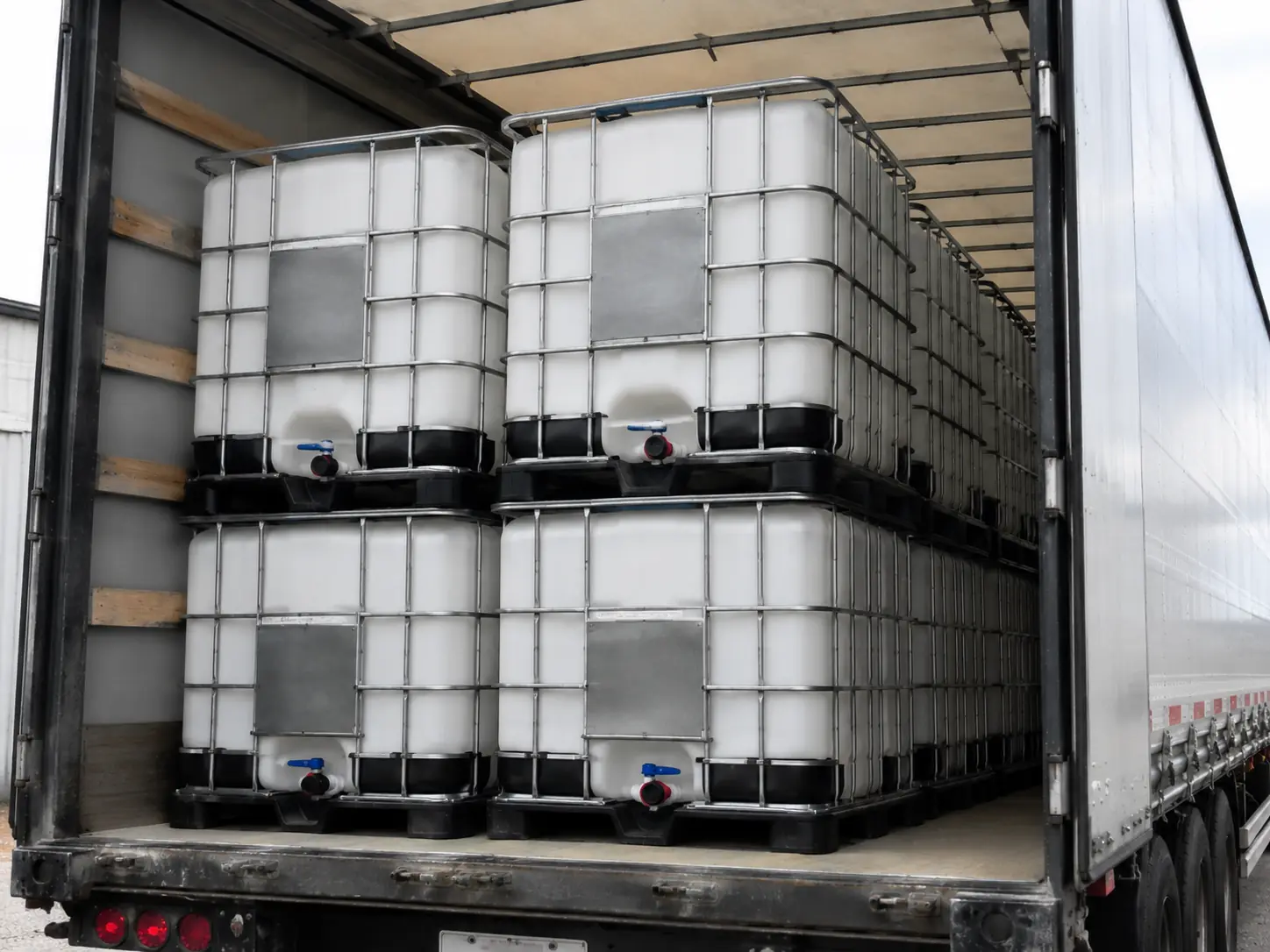
In 2016 we started collecting regularly from the businesses around the Hunts Point food distribution centre. Within a year it had changed how we run the yard, and by 2017 it had cost us the price of an entire second wash line.
What comes out of a food corridor
Edible oil, syrup, brine, fruit concentrate, vinegar, glycerine, liquid egg, molasses. Containers that look appalling and are, from a contamination standpoint, close to pristine.
The commercial significance is straightforward: a container with a documented food-only history is worth roughly double an otherwise identical one with an industrial history, because it opens the food-grade market. And the food-grade market is chronically short of supply, because a single-trip food history is destroyed the moment anyone puts anything else in the container.
So here was a borough generating exactly the stock the market could not get, and most of it was being handled by operators who did not distinguish it from anything else. Containers that could have been sold as food-grade were being washed on solvent lines and sold as industrial for half the money.
The problem with a shared wash line
We ran food and industrial through the same bay for our first two years in that trade, with a documented deep-clean changeover between them. On paper it was a controlled process. In practice it had a defect we could not engineer around.
Cross-contamination in a wash line is invisible. You cannot inspect for it, the customer cannot detect it, and if it happened nobody would find out until the product downstream was already sold. Every other control in our yard produces evidence — a test result, a photograph, a pressure hold. This one produced nothing but a signature saying somebody had cleaned the equipment.
The principle we settled on
A control you cannot verify is not a control. If the only assurance is that a procedure was followed, and no measurement can confirm it, the risk is unmanaged however good the paperwork looks.
So we built a separate room. Different bay, different spray heads, different chemistry, and no solvent work has ever run through it. It was expensive and it is the decision we are most confident about.
What the food line actually does differently
- Potable water throughout, including the pre-rinse.
- Food-safe detergent rather than caustic — caustic is more effective and leaves a residue problem we do not want to manage on this line.
- Final rinse tested for total organic carbon, and the container does not move until it comes back below 5 ppm.
- Hot-air drying under filtered air rather than ambient, because a warm damp sealed container grows biofilm faster than most of what it previously held.
- Sealed and tamper-banded immediately, so it arrives as clean as it left.
- Interior photographed and filed against the serial.
The documentation chain
Physical separation is only half of it. A food-grade claim is a claim about history, and history is a paperwork problem.
Every unit we sell as food-grade carries a prior-contents declaration from the original filler, the wash certificate with its measured TOC result, the leakproofness record, and interior photographs — all keyed to one serial number. If any of those four is missing, the container is sold as industrial, regardless of how good it looks.
We have had customers argue with this, usually because a container is visibly spotless and the declaration got lost. The answer is always the same, because the alternative is a food-grade market where the term means nothing.
What it means if you are buying
Food-grade stock is the tightest category we hold and it moves fast. If you need volume, reserve ahead rather than calling on the day. And if a supplier offers you food-grade containers without producing a prior-contents declaration, you are not buying food-grade containers — you are buying clean-looking ones.
Ana-Marie Petrescu is the wash line supervisor at IBC Tote Recycling NY in Astoria, Queens. We publish the figures we work from — if you think one of them is wrong, tell us.