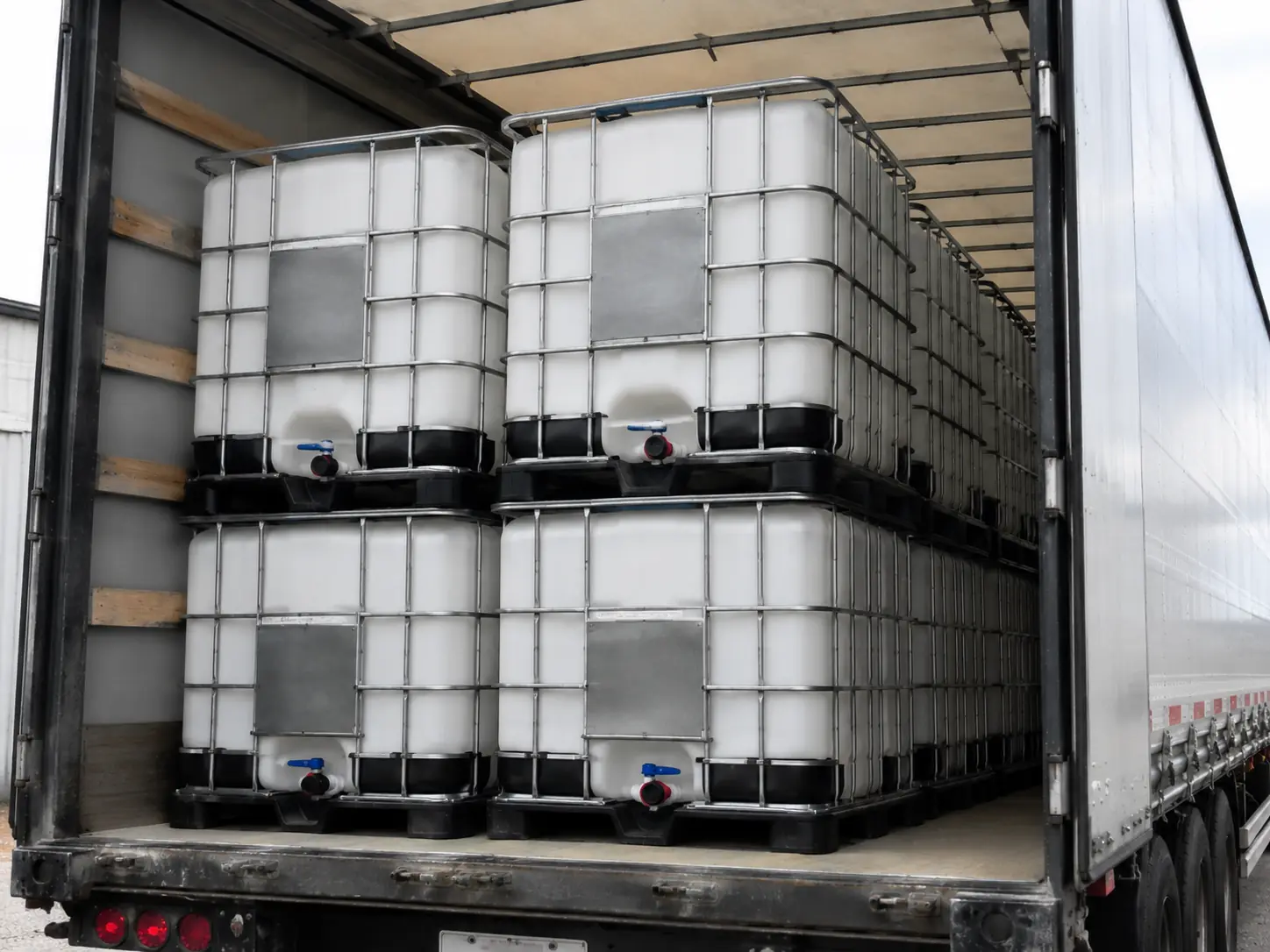
Search any marketplace for food-grade IBC totes and you will find hundreds. A meaningful proportion of them are not food-grade in any sense that would survive a question, and the sellers are mostly not lying — they genuinely believe the term means what they think it means.
What sellers usually mean
- "It is clean." It looks clean inside. This is the most common one and it is worth nothing, because solvent containers look immaculate and molasses containers look appalling.
- "It held something edible once." Possibly true, possibly what a previous owner said, with no documentation either way.
- "It says food grade on the label." A label describing the product that was in it, not the container's current status.
- "HDPE is food safe." The material is food-contact suitable when virgin. That is a statement about polyethylene, not about this container.
What it has to mean
Three things simultaneously, and the absence of any one of them makes the term marketing:
- The bottle is virgin food-contact HDPE, not regrind.
- The container's entire prior life was food, and somebody can prove it.
- It was cleaned on equipment that never handles industrial chemistry.
The second is the hard one, because it is a claim about history rather than about the object in front of you. History cannot be inspected. It can only be documented.
Why this matters more than it sounds
HDPE is permeable to many organic compounds. A container that held a solvent has that solvent in the wall, not on it, and it diffuses back out into whatever goes in next for years. No wash reaches it. This is why "it has been thoroughly cleaned" is not an answer to the food-grade question — it is an answer to a different question.
The three questions that settle it
Send these in one message to any seller, including us:
- "Can you send the prior-contents declaration from the original filler?" Not what the seller believes — the document from whoever filled it.
- "What was the total organic carbon reading on the final rinse?" A number, with a sample point. Below 5 ppm is what food-grade should mean.
- "Was it washed on a line that also handles solvents?" A scheduled changeover on shared equipment is not the same as a separate bay, and the honest answer to this question tells you a great deal about the operation.
A seller who can answer all three is running a real process. One who answers none is selling you a clean-looking container, which may be perfectly fine for your purpose — but you should be paying Grade B money for it.
What we would accept ourselves
We buy containers for our own food-grade stock and we apply exactly this test. Roughly one in five containers offered to us as food-grade actually clears it. The rest are perfectly good containers that go into industrial stock at industrial prices.
If you cannot get the documentation
Buy rebottled instead. A new, never-filled bottle in a re-certified cage has no history to document, costs 60–80% of new, and keeps 42 kg of steel in service. For anyone who needs certainty rather than a good story, it is the straightforward answer.
Ana-Marie Petrescu is the wash line supervisor at IBC Tote Recycling NY in Astoria, Queens. We publish the figures we work from — if you think one of them is wrong, tell us.