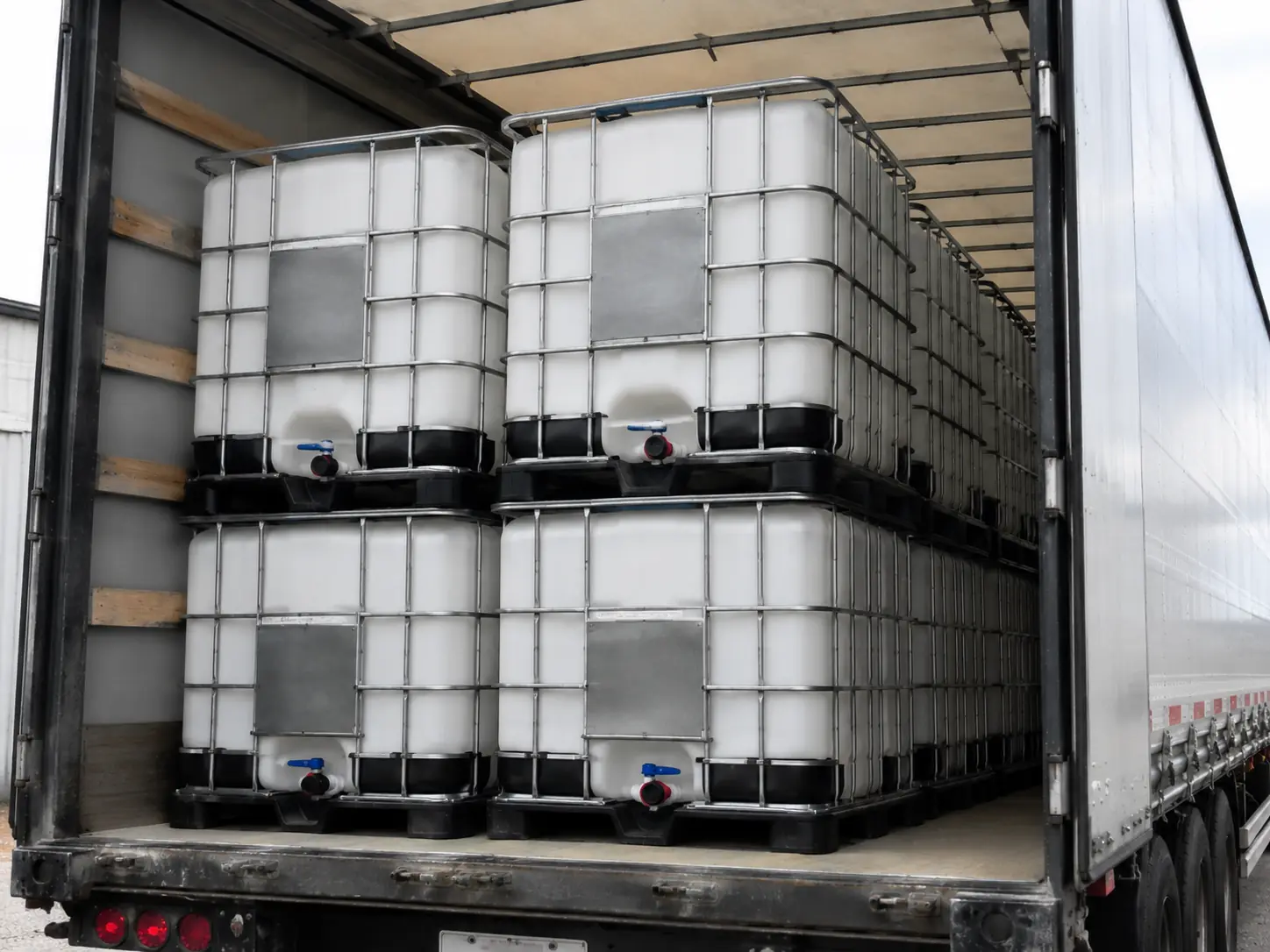
Two or three times a month somebody sends back a container asking why it is cloudy when the wash certificate says the final rinse came back at 4 ppm. The certificate is right and the container is clean. What you are looking at is not dirt.
What permeation is
High-density polyethylene is a semi-crystalline polymer. It has ordered crystalline regions and disordered amorphous regions between them, and the amorphous regions have enough free volume for small organic molecules to move into.
Fill a container with an aromatic solvent and leave it for six months and the solvent does not merely sit against the inside surface. It dissolves into the polymer matrix and diffuses outward through the wall thickness, driven by the concentration gradient. Empty the container and the gradient reverses: the solvent now diffuses back out of the wall, into whatever you put in next, slowly, for years.
The cloudiness is the physical consequence — absorbed material disrupting the way light passes through the crystalline structure. On some chemistries you get a faint amber cast instead, and on a few you get nothing visible at all.
Why washing does not touch it
Every cleaning method available to us acts on the surface. Caustic saponifies what is on the surface. Hot detergent emulsifies what is on the surface. A rotating spray head at pressure scours the surface.
None of that reaches something distributed through a 2.5 mm wall. You could wash a permeated container for a week and change nothing except your water bill. This is why our answer to "can you get it food-grade again" is always no, and why anyone who says yes is either not thinking about it or hoping you are not.
The counterintuitive bit
The containers that look worst are usually fine. Molasses, syrup and edible oil leave dramatic dark staining and no permeation to speak of — they wash out and the container is genuinely food-grade. Solvents leave a container looking almost new and make it permanently industrial. Appearance is close to useless as a guide.
What determines how bad it gets
- Chemistry. Aromatics, chlorinated solvents and some ketones permeate readily. Aqueous acids, bases and brines barely permeate at all — they attack the surface if anything, which is a different problem.
- Time. A two-day fill is very different from a nine-month storage. Diffusion is slow and cumulative.
- Temperature. Every 10°C roughly doubles the diffusion rate. A container stored full in a hot yard has taken up far more than one in a cool warehouse.
- Concentration. Neat solvent is worse than a dilute solution, in a way that is not linear.
What it means commercially
A permeated container is not scrap. It is an industrial container for the rest of its life, and there is a large, perfectly legitimate market for those: solvents, coatings, resins, ag chemistry, waste consolidation. It should be priced and documented as such.
What it must never be is sold as food-grade because it cleaned up nicely. That is the failure mode this whole industry has to police itself on, because the buyer cannot detect it and neither can their customer.
If you need a virgin bottle
Rebottling. A new, never-filled HDPE bottle in a reclaimed and re-certified cage gives you a container with no permeation history at all, at 60–80% of the price of new, while keeping 42 kg of steel in service. It is the correct answer whenever prior contents rule out reuse of the bottle itself.
Ana-Marie Petrescu is the wash line supervisor at IBC Tote Recycling NY in Astoria, Queens. We publish the figures we work from — if you think one of them is wrong, tell us.