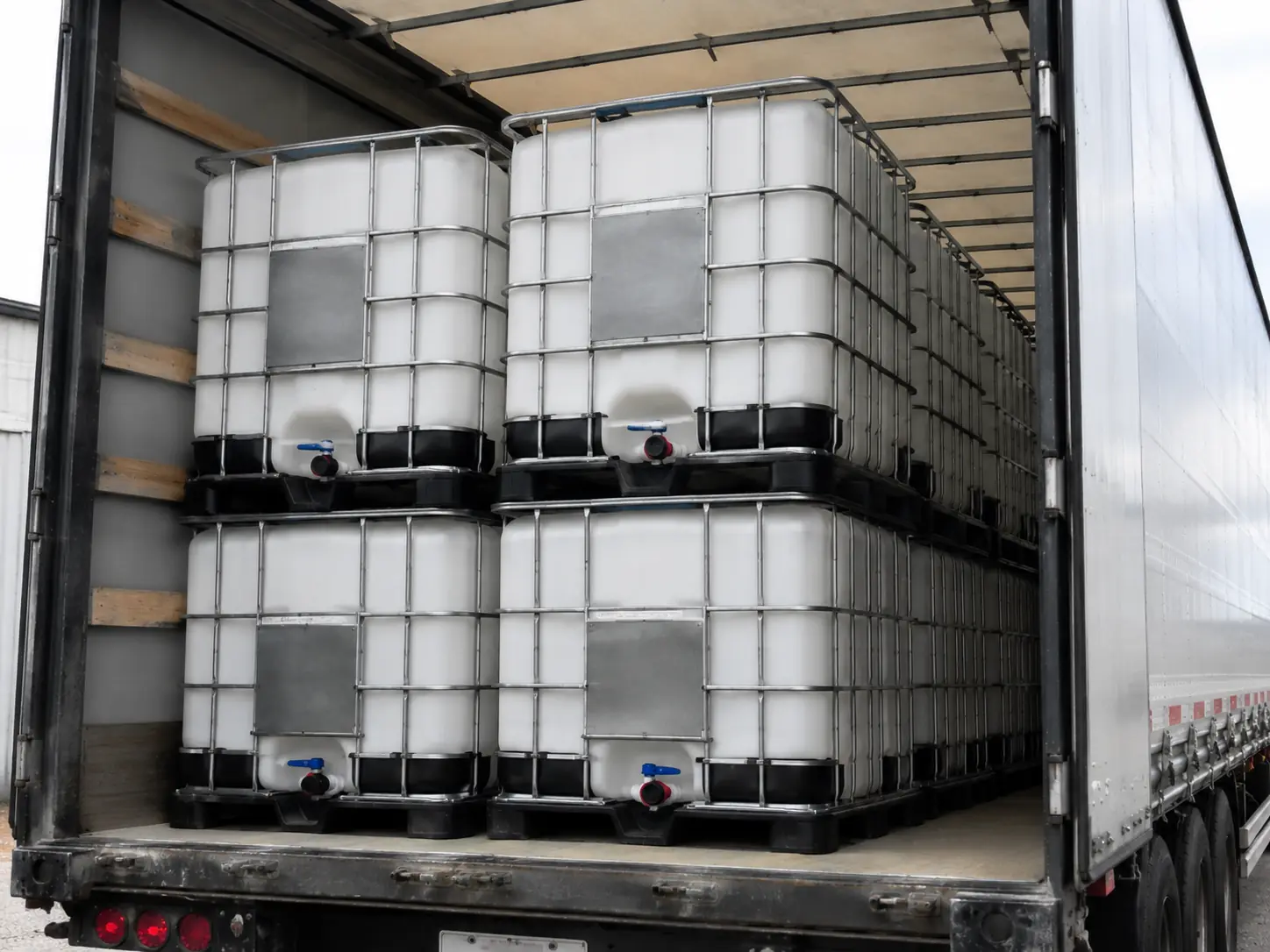
Polyethylene behaves differently at different temperatures in ways that are easy to forget, because at room temperature it behaves like a rigid solid. It is not one, and three separate effects catch people out.
The working range
For a standard composite IBC, treat the safe continuous working range as roughly −18°C to 60°C, with the upper end depending heavily on load.
HDPE has a melting point around 130°C, which is irrelevant — the container is unusable long before that. The practical limits are set by softening and creep, not melting.
Effect one: softening under load
As temperature rises, HDPE loses stiffness progressively. At 60°C it is noticeably softer than at 20°C; at 80°C it is soft enough that a filled container will visibly deform in its cage.
The load matters more than the temperature. An empty container at 70°C is fine. A full container at 70°C, with another one stacked on it, is a container that will be a different shape tomorrow.
Effect two: creep
This is the one people genuinely do not expect. Under sustained load, HDPE deforms slowly and permanently — not elastically. Remove the load and it does not come back.
Creep rate rises sharply with temperature, which is exactly why the UN stacking test for plastics IBCs is run at 40°C for 24 hours rather than at room temperature for five minutes. The standard is testing for this specific behaviour.
Practically: a stack that is entirely stable through a New York March can slowly deform through a July heatwave, and the deformation is permanent. If you stack outdoors, take a container off the stack for summer.
Hot filling, done properly
Fill below 60°C where you can. Above that, do not stack anything on the container until it has cooled to ambient, leave the lid vented during cooling, and expect the bottle to draw inward slightly as the contents contract — that is normal and reverses on the next fill. What is not normal is a permanent panel-in, which means it cooled sealed and pulled a vacuum.
Effect three: cold
HDPE stays ductile far below anything New York produces — its glass transition is around −100°C, so the material itself is not the problem in winter.
The problem is what is inside it. Water expands 9% on freezing and the container has nowhere to put it. A partly full container is worse than a full one, because the ice plug forms at the top and pressurises the liquid below it against a closed valve. Split valves and blown outlet gaskets in February almost always come from part-filled containers.
The rule is: below a third full, or empty and drained, with the valve open and tilted so the outlet passage clears.
Thermal shock
Pouring hot water over a cold bottle to loosen viscous product is a common yard improvisation and a bad one, particularly on a container that has any UV degradation. Rapid differential expansion across a wall that has lost ductility cracks it.
Warm the whole container slowly with a band heater and a jacket instead. It takes eight hours instead of ten minutes and it does not cost you a container.
What we check on incoming containers
Panel deformation, out-of-square cages, and any permanent bulge below the halfway line. All three are signatures of thermal history — either a hot stack or a freeze — and all three mean the container has been somewhere its previous owner probably did not record.
Ana-Marie Petrescu is the wash line supervisor at IBC Tote Recycling NY in Astoria, Queens. We publish the figures we work from — if you think one of them is wrong, tell us.