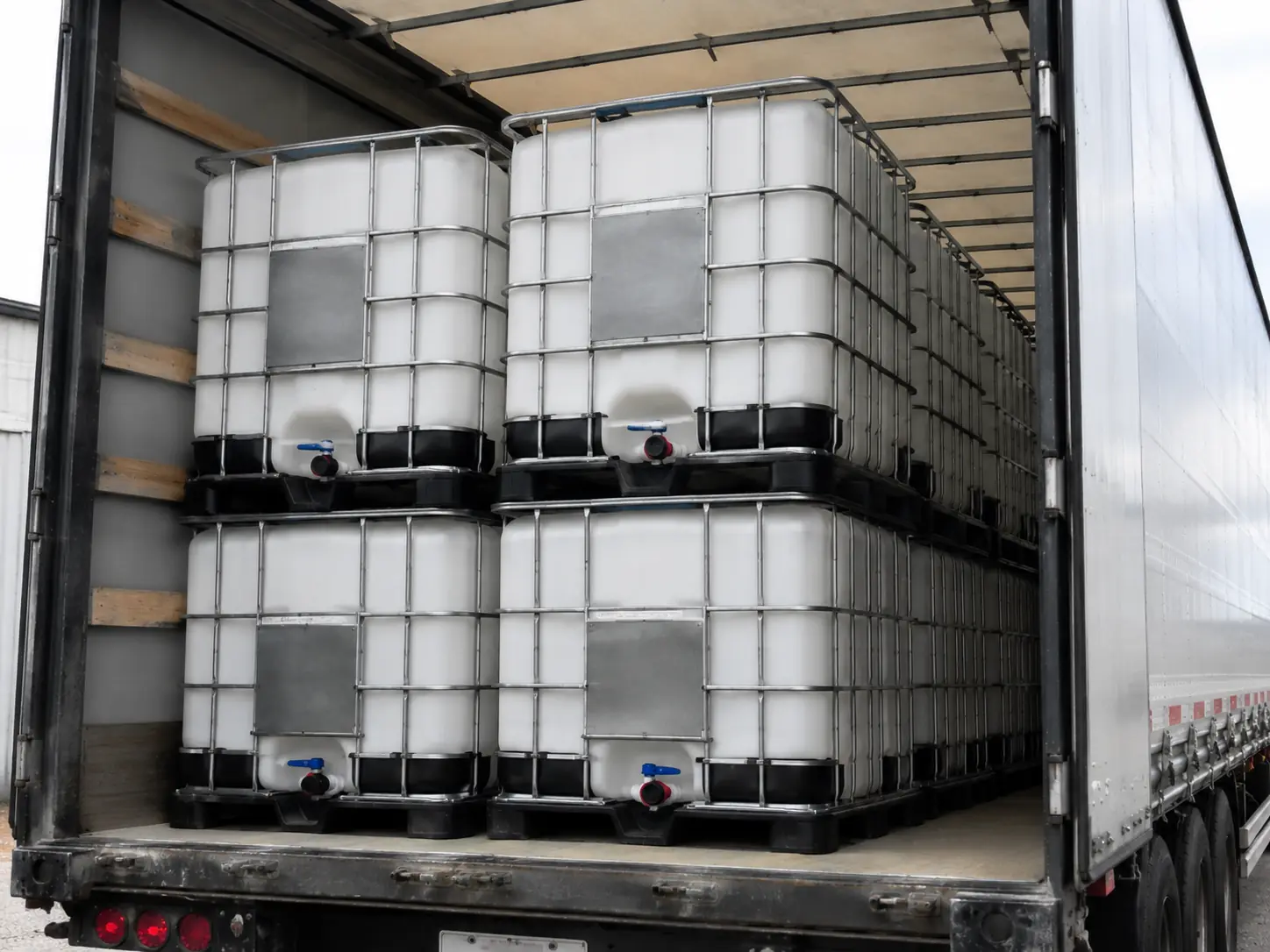
We put roughly 180 containers a week across the inspection bench. Bottles fail in five distinct ways, they look different from one another, and only two of them are recoverable. Knowing which is which will save you from buying a container with three months left in it.
1. Environmental stress cracking
The most common failure and the one people miss. HDPE under sustained tensile stress, in contact with a surfactant or a solvent, develops fine cracks that propagate slowly along the direction of moulding stress. You see them as hairline silver lines, usually radiating from the outlet collar or from a point where the cage has pressed into the wall.
They are invisible when the container is empty and they weep when it is full. If you have ever had a tote that was dry in the yard and had a puddle under it two days after filling, this was why.
Not repairable. A cracked bottle goes to granulation and the cage goes to the rebottling bench.
2. UV embrittlement
Natural HDPE left in the open loses ductility. The surface goes chalky, then the material becomes brittle enough that a forklift nudge that would have bounced off a new bottle puts a hole in it. In a New York yard, a container stored uncovered in full sun is visibly degraded in two summers.
You test for it with your thumbnail: on a healthy bottle you get a faint mark that recovers, on an embrittled one you get a white stress mark that stays. Chalk on your fingers after rubbing the wall is the other tell.
Not repairable, and worth pricing into any purchase of yard-stored stock. This is the single biggest reason we discount containers that arrive from an uncovered site.
3. Permeation
Not a mechanical failure at all — the bottle still holds liquid perfectly. But an organic compound has migrated into the polymer wall and will leach back out for years. You see it as permanent cloudiness or a faint amber cast, and you smell it at the valve body long after the container has been washed.
This is the failure that matters most commercially, because the container looks fine. A permeated bottle can never go back to food service and should never be sold as anything but industrial.
The trap in one sentence
A tote that held molasses looks disgusting and is perfectly good; a tote that held a chlorinated solvent looks pristine and is permanently industrial. Appearance and risk are close to uncorrelated, which is why we grade on documentation first.
4. Impact damage
A forklift tine through the cage, a drop from a tail lift, a pallet corner from the unit stacked above. Usually obvious. What is less obvious is the bulge: a container that has been over-filled with a dense product, or frozen, deforms outward without cracking and then never sits square in the cage again.
Sometimes recoverable. A bulged but sound bottle can go to Grade C static storage. A punctured one cannot go anywhere but the granulator.
5. Collar and outlet failure
The threaded collar around the outlet takes every bit of torque anyone has ever applied to a valve, and there is always somebody with a pipe wrench. Cross-threading, over-torquing and levering all crack the collar, and once cracked it will not seal against any gasket.
This is the one failure that is genuinely repairable in some designs, where the outlet assembly is a separate moulded part. On a one-piece bottle it is terminal.
What happens to the ones we cannot fix
The bottle is rinsed, granulated and sold as clean HDPE regrind into non-food durable goods. The cage goes on the jig, gets straightened and re-welded, and takes a new bottle at the rebottling bench. About 42 kg of galvanised steel stays in service rather than going back to a furnace.
That split is the whole reason composite totes dominate the reuse market. The consumable part and the permanent part are separable, which means a bottle failure is a repair rather than a write-off.
Danny Foulkes is the yard manager at IBC Tote Recycling NY in Astoria, Queens. We publish the figures we work from — if you think one of them is wrong, tell us.