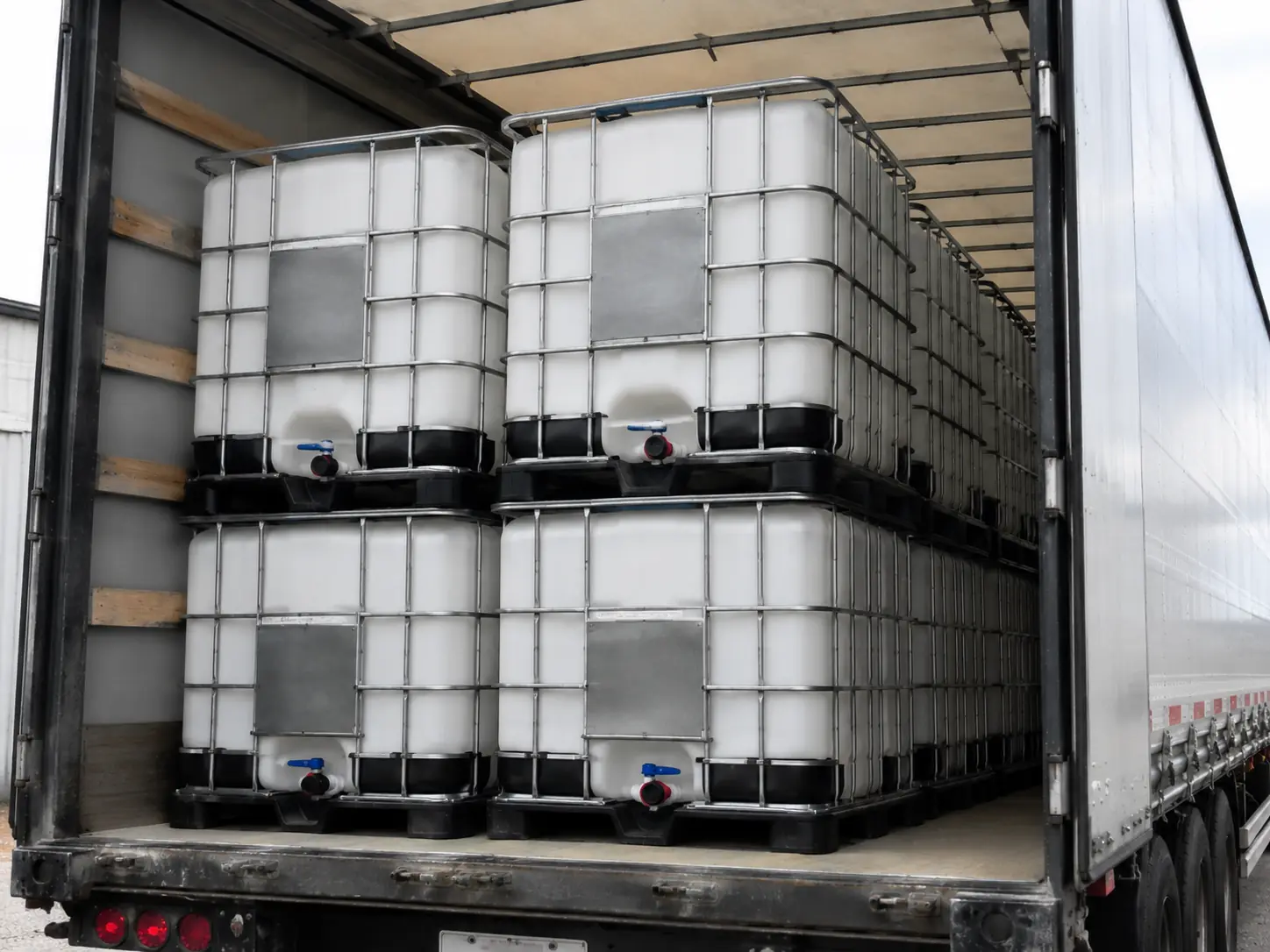
Rebottling is the least understood product in this trade. People hear 'used cage' and mentally file it next to Grade B, when in fact a rebottled unit gives you a virgin bottle, a fresh UN marking and dangerous-goods approval — the same functional outcome as new, at 60–80% of the price.
Why the two halves are worth so differently
A 275-gallon composite tote is roughly 59 kg of tare: 17 kg of blow-moulded HDPE in the bottle and 42 kg of galvanised steel in the cage and pallet frame. By mass the steel dominates. By replacement cost the split is closer to even, and by lifespan the two are nowhere near each other.
The bottle is a consumable. UV, permeation and stress cracking all attack it, and three to five service cycles is a realistic life. The cage is close to permanent — it gets bent, we straighten it; it gets a broken weld, we re-run it. We have cages on their fourth bottle.
Scrapping a sound cage because its bottle has failed is the most wasteful habit in industrial packaging, and rebottling exists purely to stop it.
The numbers
- New 275-gallon UN 31HA1: $385–$620 depending on pallet base and gasket.
- Rebottled equivalent: $240–$395.
- Saving: roughly $145–$225 per unit, or a third off.
- Avoided emissions versus new: about 78 kg CO₂e per unit — the steel you did not have to smelt.
- Avoided emissions versus reconditioning: none. Reconditioning saves 125 kg because it also avoids the new bottle.
The honest ranking
If your job will tolerate a used bottle, recondition — it is cheaper and greener. Rebottling is for when it genuinely will not: permeation history, a customer specification demanding virgin resin, a missing or expired UN plate, or a food-grade requirement the used market cannot supply that month.
What we do to the cage
This is where a rebottled unit is either legitimate or worthless, and the difference is invisible on an invoice.
Every reclaimed cage goes on a geometry jig. Bowed corner posts are straightened, broken welds are re-run, corroded feet are replaced, and the pallet base is checked for four-way tine clearance. A cage that will not come back to specification goes to the steel mill rather than into a build — we scrap roughly one in six.
It is then re-plated under our own approval with a fresh design-type marking, and the build is recorded so we know which cage received which bottle. That last part matters when a unit comes back to us in five years.
The two cases where rebottling loses
First, matched fleets. If you need forty visually identical containers with sequential serials for a validation protocol or a customer audit, buy new. Reclaimed cages vary in age, finish and manufacturer, and no amount of straightening makes them uniform.
Second, when the cage itself is the specification. A small number of applications require a particular cage gauge, a powder-coated finish or a specific pallet material that we simply cannot guarantee from reclaimed stock.
Supplying your own cages
If you have accumulated cracked bottles in sound steel — and most fleet operators have, sitting in a corner somewhere — send them in. We assess how many pass the jig and rebottle those. It is usually the cheapest route to a compliant container that exists, and it turns a pile of scrap into working stock.
The pass rate on customer-supplied cages runs around 70%, which is higher than people expect. Steel is forgiving in a way that plastic is not.
Teddy Grant is the buyer at IBC Tote Recycling NY in Astoria, Queens. We publish the figures we work from — if you think one of them is wrong, tell us.