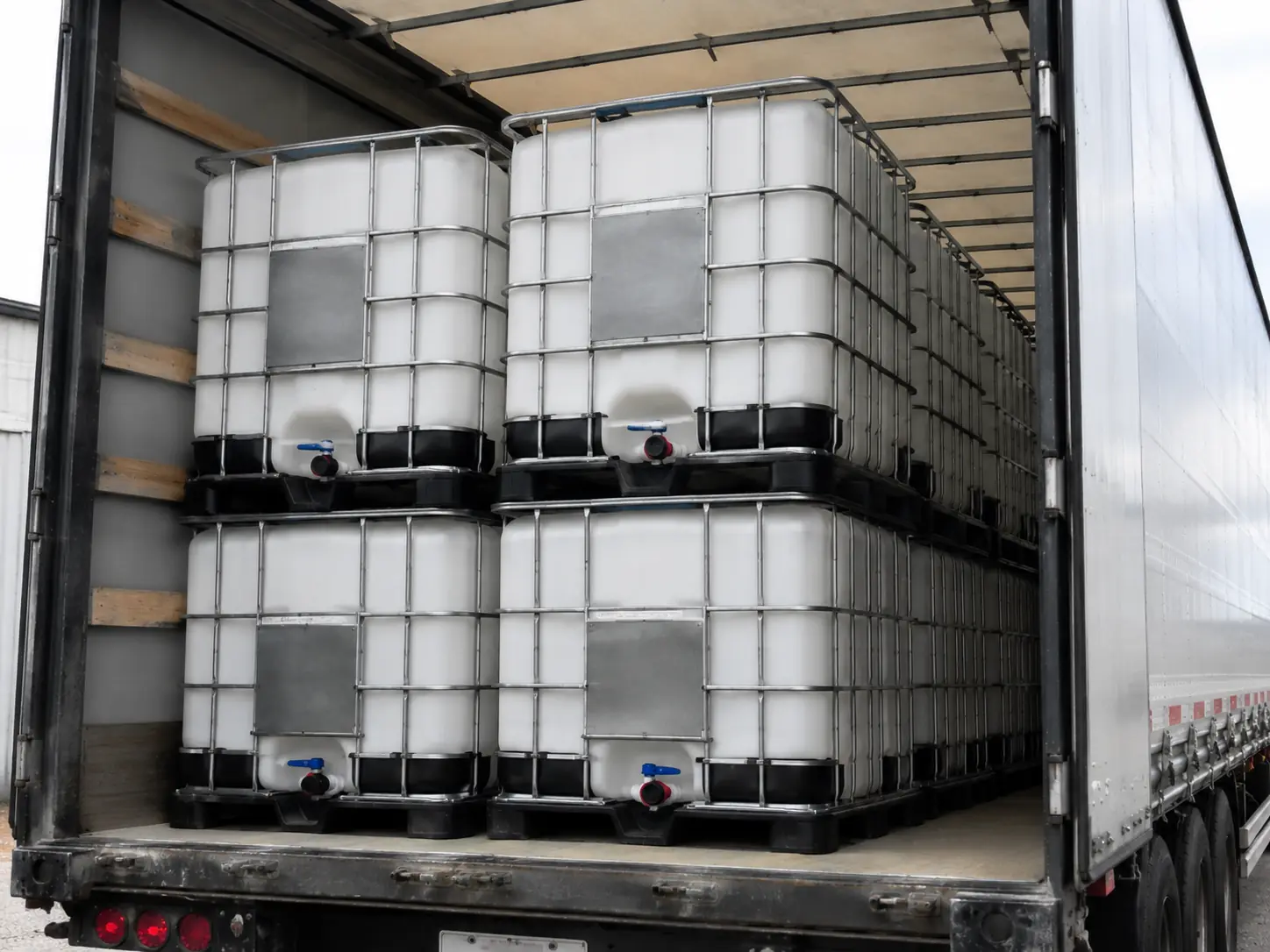
Almost every enquiry we get opens with the purchase price. It is the wrong number to lead with, and the gap between it and the real cost of ownership is where most of the money in this trade gets quietly lost.
Below is the five-year arithmetic for a single 275-gallon container in a moderate-duty application — roughly eight fill cycles a year, stored under cover, moved by forklift. The figures come from what we actually invoice and what we actually pay back at end of life, not from a spreadsheet someone built to make reconditioning look good.
The three routes
Buy new — $470 all-in
- Purchase: $455 for a UN 31HA1 unit with a steel pallet base.
- Delivery, amortised across a full trailer: $15.
- Requalification at 2.5 years: $0 — the original marking covers the first window, and most operators sell before the second.
- End-of-life resale to us at year five: −$62 for a well-kept unit.
- Net five-year cost: about $408, or $10.20 per fill cycle.
Buy reconditioned Grade A industrial — $215 all-in
- Purchase: $205.
- Delivery: $10 amortised.
- Requalification at 2.5 years: $38 if the unit stays in dangerous-goods service.
- One valve replacement across five years: $22. Budget for it; the valve always goes first.
- End-of-life resale: −$34.
- Net five-year cost: about $241, or $6.03 per fill cycle.
Rent — $22 per month
- 60 months at $22: $1,320.
- Delivery, collection and end-of-term wash: included.
- Requalification, repairs, replacement: our problem, not yours.
- Net five-year cost: $1,320, or $33 per fill cycle.
The obvious conclusion, and the less obvious one
Over five years of steady use, renting costs roughly five times what buying reconditioned does. That is not an argument against rental — it is an argument against renting for five years. Rental is priced for a defined window, and it wins decisively under about ten months. Past that, the maths flips hard.
The lines people forget
Three costs never appear on the purchase order and routinely dwarf the difference between grades.
The first is storage. A 275 occupies 13.3 square feet of floor. At Queens warehouse rates of roughly $22 per square foot per year, that is $293 a year — more than the container cost. Anybody sitting on forty spare totes 'because they were cheap' is renting a parking space for $11,700 a year.
The second is aborted movements. A delivery that cannot be unloaded because nobody checked the door height costs us a truck and costs you a day. We see this several times a month and it is entirely preventable with a five-minute site check.
The third is the one that actually hurts: buying the wrong grade and discovering it at the point of use. A Grade B unit bought to save eighty dollars, then found to be unusable because the customer downstream needs a current UN mark, is not an eighty-dollar mistake. It is a stopped shipment.
Where reconditioned genuinely loses
We sell reconditioned containers and we will still tell you when new is right. If you need forty identical units with sequential serials, matched gaskets and a documented build date for a validation protocol, buy new. The used market cannot promise uniformity, and pretending otherwise wastes everyone's week.
The other genuine case is very high cycle counts. Above roughly twenty fills a year, container condition degrades fast enough that the reconditioning saving is eaten by earlier replacement. At that intensity, buy new and sell it to us at three years while it still has resale value.
What we would do
For most operations moving non-regulated liquid on their own site: Grade B, replace the valve on arrival, store under cover, sell it back at five years. Total cost per fill cycle lands under five dollars and the environmental saving is 125 kg CO₂e a unit.
For regulated product: reconditioned Grade A with a live retest, and put the requalification dates in a calendar the day the containers arrive. The single most expensive thing in this trade is discovering a lapsed retest on the morning a truck is loaded.
Teddy Grant is the buyer at IBC Tote Recycling NY in Astoria, Queens. We publish the figures we work from — if you think one of them is wrong, tell us.