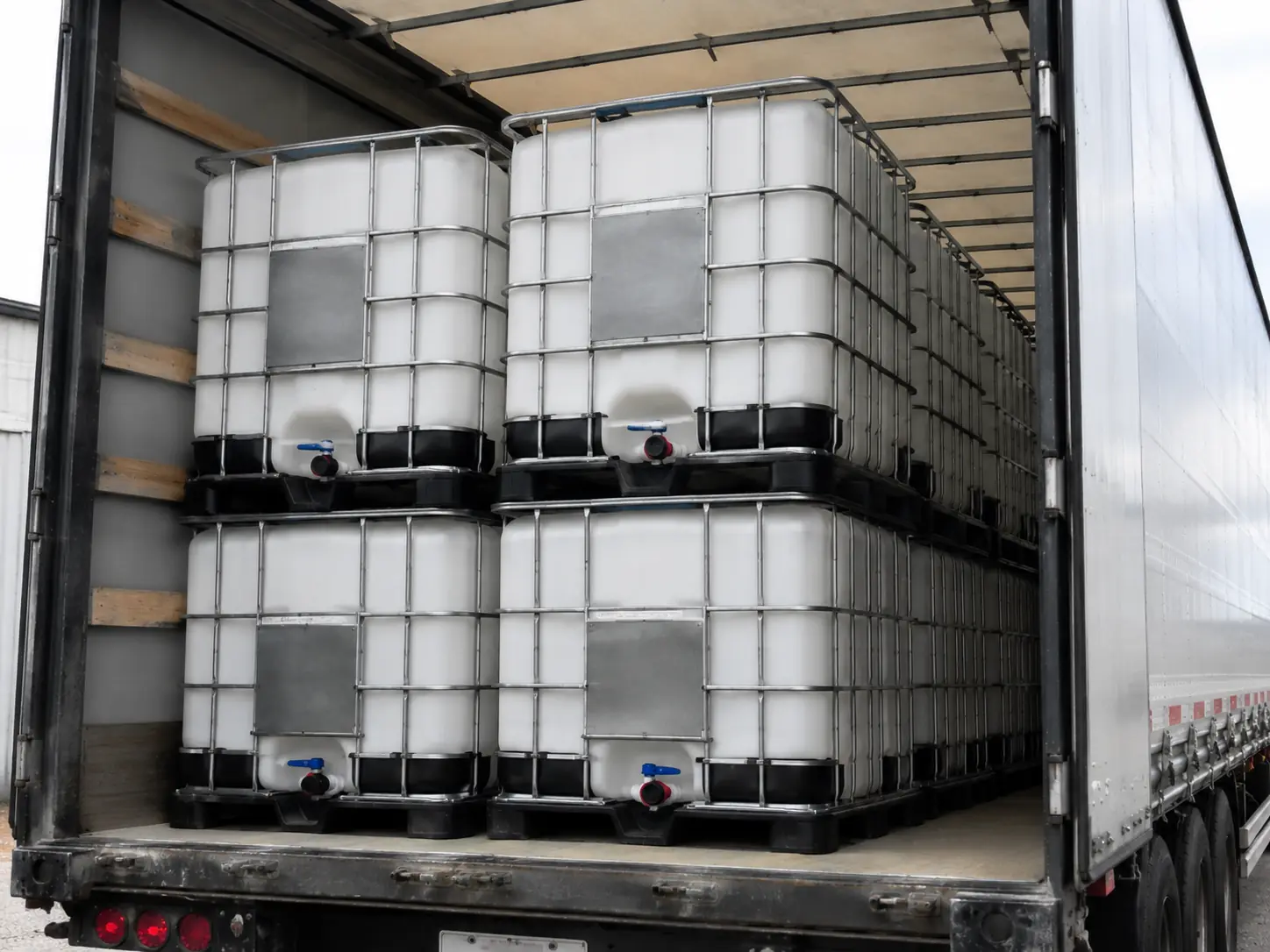
Discharging a tote looks like the simplest operation in the whole cycle and it generates more calls to us than anything except valves. Three problems account for nearly all of them.
Problem one: it stops halfway
A container discharging under gravity with the lid sealed pulls a partial vacuum in the headspace. The bottle panels inward, the pressure differential rises, and flow slows and then stops entirely — usually somewhere around half empty.
People conclude the valve is blocked. It is not. Crack the lid or fit a vented cap and it resumes immediately.
This is also why the label on nearly every tote says to vent before discharging and close after. Leaving the lid off permanently is not the answer either — an open container collects grit, insects and rain, and on volatile products it is a vapour problem.
Problem two: the last twenty litres
The outlet sits slightly above the base and the base itself is not perfectly flat. Gravity will never get the last fifteen to twenty-five litres out of a 275, and on viscous product it is considerably more.
The standard fix is a tilt: 50–75 mm of packer under one side of the pallet, on the opposite side to the outlet. It costs nothing and recovers most of it. A dedicated tote tipper does the job properly if you are discharging containers all day.
What remains after that is the heel, and it is worth remembering that it legally remains the product it held, with the same hazard classification. It goes into characterised collection, not down a drain.
Problem three: choosing a pump
Gravity
Free, silent, no maintenance. Fine for thin liquids into a container lower than the outlet. Slow, and useless for anything viscous or any transfer that has to go uphill.
Air-operated double diaphragm
The workhorse. Self-priming, runs dry without damage, handles viscous product and some solids, and stalls safely against a closed valve. Needs compressed air, which is the only real drawback. This is what we use on the yard.
Electric drum pump
Convenient where compressed air is not available. Choose the impeller material for the chemistry — polypropylene for aqueous, stainless for solvents — and be careful with flammables, where you need a properly rated unit rather than a general-purpose one.
Peristaltic
The right answer for anything abrasive, shear-sensitive or where cross-contamination between products matters, because only the tube touches the product. Slower and the tubes are a consumable.
Open the valve fully
Throttling flow at a butterfly valve sends product past a partly open disc at high velocity and erodes the seat, which is how a perfectly good valve starts weeping a month later. Open it fully and control the flow downstream, at the pump or a downstream valve.
Fittings
The outlet is an S60x6 or S70x6 buttress thread — coarse and asymmetric, and emphatically not NPT. You need the correct adapter, which costs a few dollars and is in stock. No amount of PTFE tape makes a hose fitting behave on a buttress thread, and trying is how outlet collars get cracked.
A 2-inch camlock adapter on the outlet is the single most useful accessory on a tote. Fit one and every hose in your building connects in two seconds.
Danny Foulkes is the yard manager at IBC Tote Recycling NY in Astoria, Queens. We publish the figures we work from — if you think one of them is wrong, tell us.