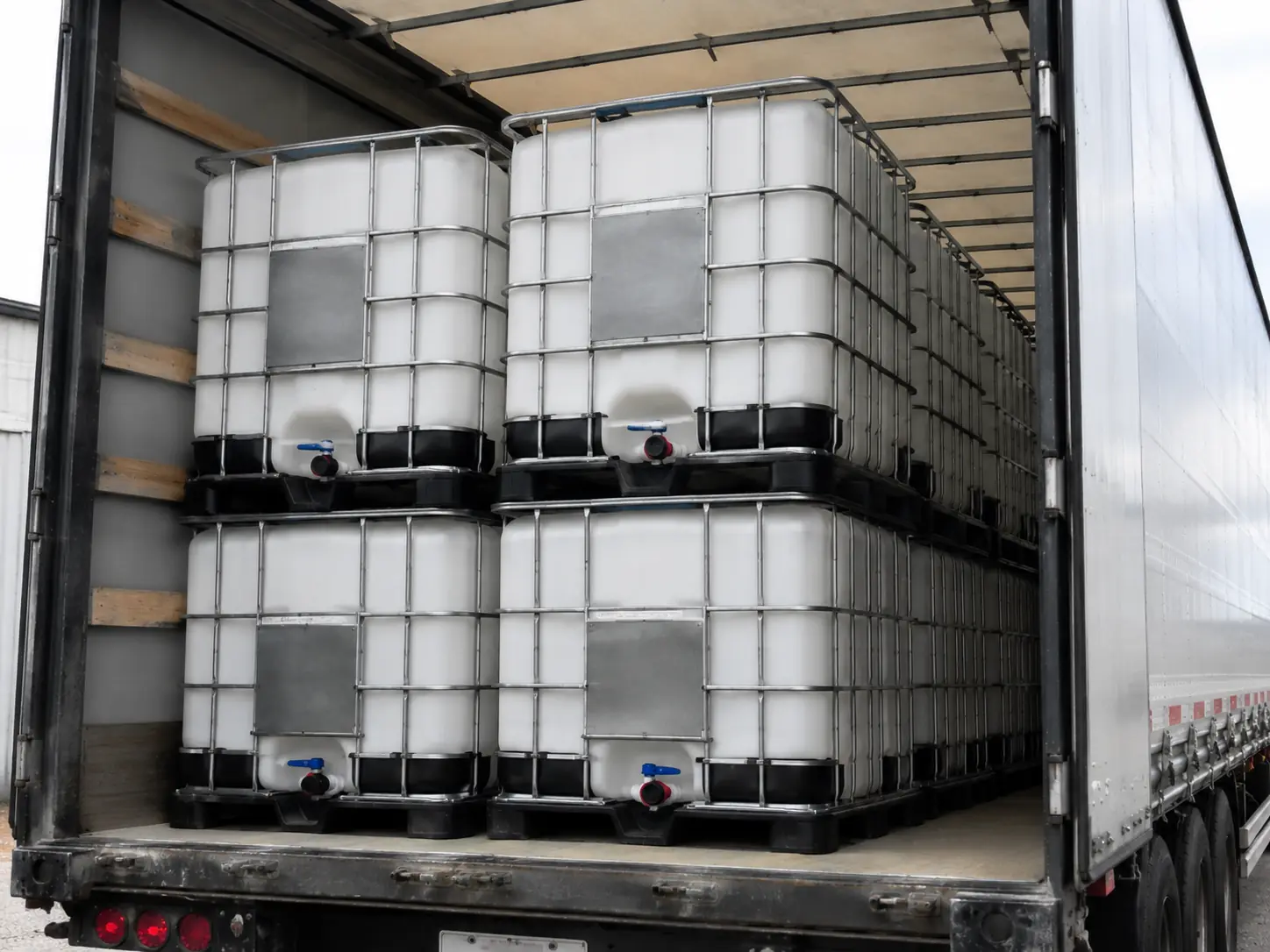
Every January somebody calls to say a container is blocked. It almost never is. The product has simply become too viscous to move through a two-inch outlet, and the container is fine.
What actually happens
Viscosity rises steeply as temperature falls, and for many products the curve is much sharper than people expect. A resin that pours freely at 20°C can be effectively immobile at 5°C. Vegetable oils cloud and partially solidify. Surfactant blends can gel. Some fertiliser solutions crystallise out and then genuinely do block the outlet.
The failure is nearly always at the outlet rather than in the bulk, because the outlet is the coldest, thinnest, least insulated part of the container and it is where flow has to accelerate.
The three heating options
Insulated jacket, no heat
A quilted cover that slows heat loss. Cheap and useful for holding a warm container warm overnight. Useless for recovering a container that is already cold, because it adds no energy — it only slows the loss.
Band heater plus jacket
The standard answer. A heating band around the lower third of the container, an insulated jacket over the top, and a thermostat. Typically 1–2 kW, and it will bring a cold 275 up over eight to twelve hours.
The mistake people make is sizing for the average temperature rather than the worst night. A jacket rated to hold 15°C above ambient is no use in a −12°C snap if the product needs to stay above 5°C.
Hot box or warm room
Overwhelmingly the best result if you have the space. Even a modest heated store at 15°C solves the problem for everything, needs no equipment per container, and removes the fire-risk conversation entirely.
The mistake that wastes a morning
Heating a container that is only a third full. The band warms the wall, the wall warms the air in the headspace, and the product sitting at the base is exactly as cold as it was. Heaters must be positioned against the liquid, and on a part-full container that means low, not at the level where the band happens to sit comfortably.
What not to do
- No direct flame, ever. HDPE and open flame is a category error, and quite a few products in these containers are flammable.
- No hot water above about 60°C poured over a cold bottle. Thermal shock on degraded HDPE cracks it.
- Do not heat a sealed container hard. Expanding headspace and expanding product need somewhere to go — vent it, or use a vented cap.
- Do not put a band heater on a container with an unknown product. Some things become considerably more interesting when warm.
The discharge itself
Once warm, get it out fast. A pump beats gravity for anything viscous, and a 2-inch camlock into a diaphragm pump moves material that will not gravity-feed at all. Open the valve fully — throttling at the valve is exactly what erodes the seat.
And vent the lid before discharging. A sealed container discharging under gravity pulls a partial vacuum, the bottle panels inward, and flow stops entirely. That one catches new operators every winter and it takes two seconds to prevent.
Danny Foulkes is the yard manager at IBC Tote Recycling NY in Astoria, Queens. We publish the figures we work from — if you think one of them is wrong, tell us.