Abstract descriptions of a service are less useful than one concrete account, so here is a real clearance from start to finish, with the numbers.
Tuesday: the email
A coatings manufacturer in Carlstadt, consolidating two buildings into one, with roughly forty containers to clear before a lease ended in eighteen days. Four photographs attached: the plate on one container, an interior shot with flash, a valve, and a wide shot of the stack.
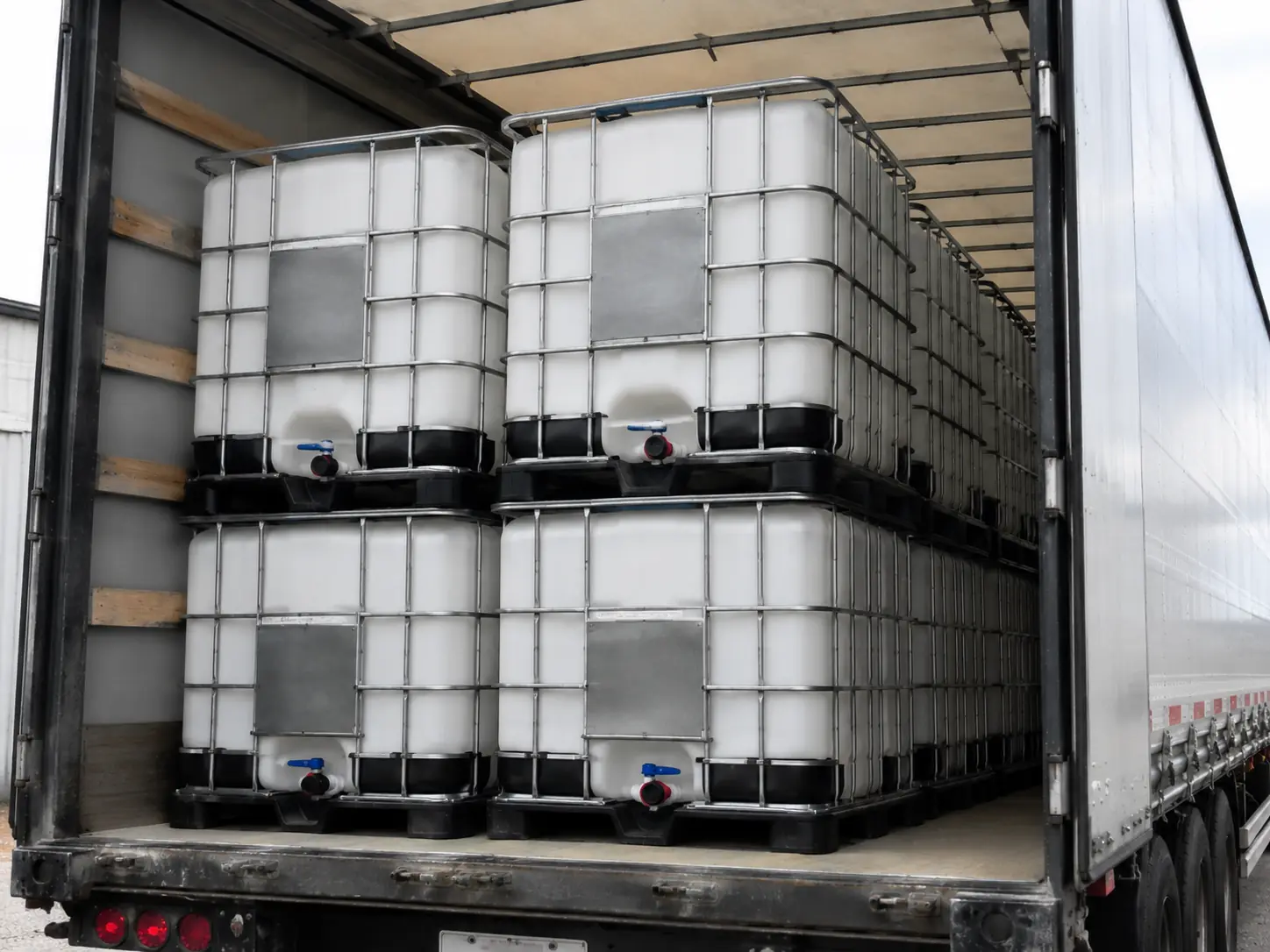
The wide shot did most of the work. It showed the containers were stored indoors, lidded, on a dry floor, in two rows of twenty — which told us they were probably Grade B or better, that a trailer could get to them, and that there were genuinely forty rather than "about forty".
The message named the prior contents — water-based acrylic emulsion and a solvent-borne alkyd on eight of them — and attached both safety data sheets. That single paragraph is the difference between a firm offer and a hedged one.
Wednesday: the offer
We quoted per grade rather than as a lump:
- 26 units, likely Grade B, water-based history: $58 each.
- 8 units, solvent history, industrial only: $41 each.
- 4 units with visible cage damage in the photographs: $24 each.
- 2 units we flagged as probable scrap from the wide shot: $18 each.
- Total: $2,000, collection free, payment on collection or net-15.
We also told them the eight solvent units would have been worth roughly double had the prior contents been water-based — not to negotiate, but because they were about to specify containers for the consolidated site and it was relevant.
Friday: the site check
Two minutes on the phone. Dock at 48 inches, forklift on site, driver certified and working that day, gate wide enough for a 53-foot trailer, and a request for an early slot so we were out before their own shift started. That last detail changed the booking from mid-morning to 6:30 AM.
The following Tuesday: the collection
Trailer on site at 6:20. Their forklift driver loaded, ours strapped and counted. Every serial recorded on a tablet as it went on. Forty-one containers — there was one behind a rack that nobody had counted, which happens more often than you would think, and we paid for it at the Grade B rate.
Off site by 8:05. Transfer note emailed before the truck left the gate, listing all forty-one serials. Payment by ACH the same afternoon.
The bit that made it easy
The safety data sheets arrived with the first email. Roughly a third of our enquiries do not include prior contents, and every one of those adds two or three days of back-and-forth before we can even quote. One attachment saved this customer most of a week against their lease deadline.
What happened to them
Twenty-four went through the standard line — wash, inspect, new valve, lid and gasket, 20 kPa test, re-plate — and were resold as Grade B within five weeks, mostly to a landscaping contractor in Suffolk County and a car wash group in Brooklyn.
The eight solvent units were washed on the industrial line and sold as Grade A industrial to a printing ink manufacturer who specifically wanted containers with a coatings history.
Six failed inspection: four with stress cracking around the outlet collar, two with bottles too degraded to reissue. All six cages passed the jig and went to the rebottling bench.
Three went to granulation. Two of those were the ones we had flagged as scrap from a photograph eleven days earlier.
The totals
Of forty-one containers, thirty-two returned to service directly, six were rebottled, three were granulated at about 94% material recovery, and none went to landfill. Avoided emissions across the load came to roughly 4.5 tonnes CO₂e — which we put on the transfer note, because the customer's parent company reports Scope 3 and asked.
Danny Foulkes is the yard manager at IBC Tote Recycling NY in Astoria, Queens. We publish the figures we work from — if you think one of them is wrong, tell us.