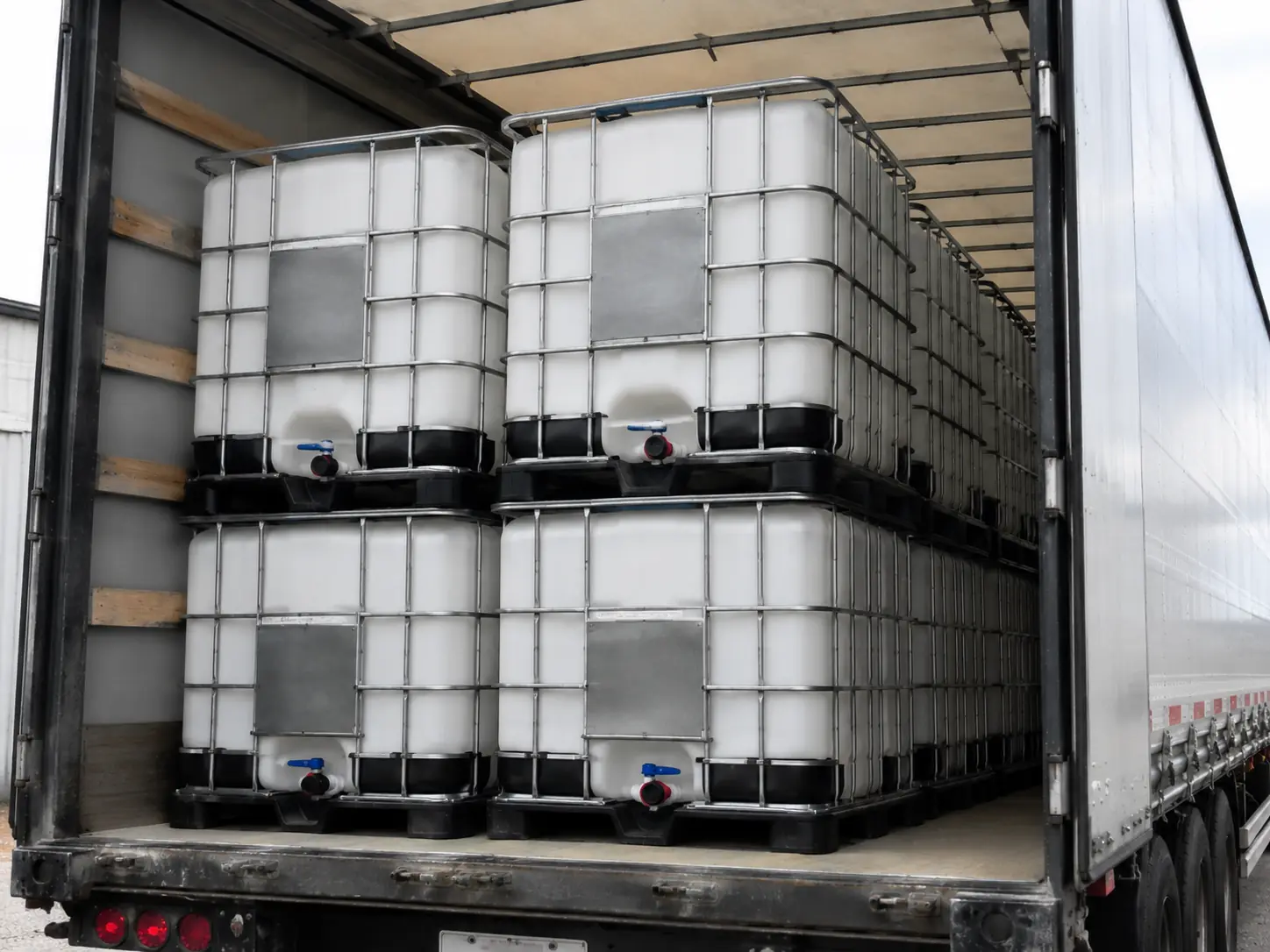
Every February we get the same calls. A yard full of split bottles, bulged cages and a puddle of whatever was in them. Freeze damage is entirely predictable, entirely preventable, and it costs New York operators more containers than forklifts do.
What actually happens
Water expands about 9% when it freezes. A 275-gallon container holding 1,041 litres of aqueous product is trying to accommodate roughly 94 extra litres it does not have room for. Something gives.
In a composite tote, the sequence is usually: the bottle bulges against the cage, the cage members deform outward, the bottle finds the point of highest stress — almost always the outlet collar or a moulding line — and splits. You often do not discover it until the thaw, when the container empties itself onto the yard.
HDPE itself does not become brittle at New York temperatures. Its glass transition is far below anything we see here. The damage is mechanical, from the ice, not from the plastic going hard.
The counterintuitive part
A full container is safer than a three-quarter-full one, and both are worse than an empty one.
A completely full, sealed container has nowhere for ice to go and will split. But a partially full container is worse in a specific way: the water freezes from the top and the sides inward, and the expanding ice plug pushes down on the remaining liquid, pressurising the lower bottle and the closed valve. Split valves and blown outlet gaskets in February almost always come from partly filled containers.
The rule we give customers
Below a third full, or completely empty and drained. Anything in between is the dangerous zone. If you must overwinter product outdoors, insulate and heat it rather than hoping.
A calendar that works in this climate
- Late October — walk the yard, list every container holding aqueous product, and decide which are coming indoors.
- First week of November — drain everything that is not needed over winter. Not the second week; our first hard freeze has landed in the first week more than once.
- Mid November — crack every outlet valve on empty containers and leave them open. A sealed empty container still collects condensate, and that freezes too.
- Through winter — after any freeze-thaw cycle, walk the yard looking for cage deformation. A bulged cage is the warning that comes before the split.
- March — inspect every overwintered container before refilling. Do not assume it survived.
Draining properly
Opening the valve is not draining. A 275 sitting level retains several litres in the base and, more importantly, in the outlet passage below the valve seat. That trapped water freezes first because the outlet is the coldest, least insulated point on the container, and it is what cracks the valve body.
Tilt the container — even 50 mm of packer under one side of the pallet — and leave the valve open and the lid off. Ten minutes of work per container.
Heaters and jackets
If product has to stay outdoors, an insulated jacket with a band heater is the standard answer, and the mistake people make is sizing it for the average temperature rather than the worst night. A jacket rated to hold 15°C above ambient is no use in a −12°C snap if the product needs to stay above 5°C.
The other mistake is heating a container that is only partly full. The heater warms the wall, the wall warms the air in the headspace, and the product at the base stays exactly as cold as it was.
What we do with freeze-damaged containers
A bulged bottle in a sound cage goes to rebottling. A split bottle goes to granulation and the cage goes on the jig. A deformed cage that will not come back true goes to the steel mill.
None of it goes to landfill, and all of it was avoidable with a morning's work in early November.
Danny Foulkes is the yard manager at IBC Tote Recycling NY in Astoria, Queens. We publish the figures we work from — if you think one of them is wrong, tell us.