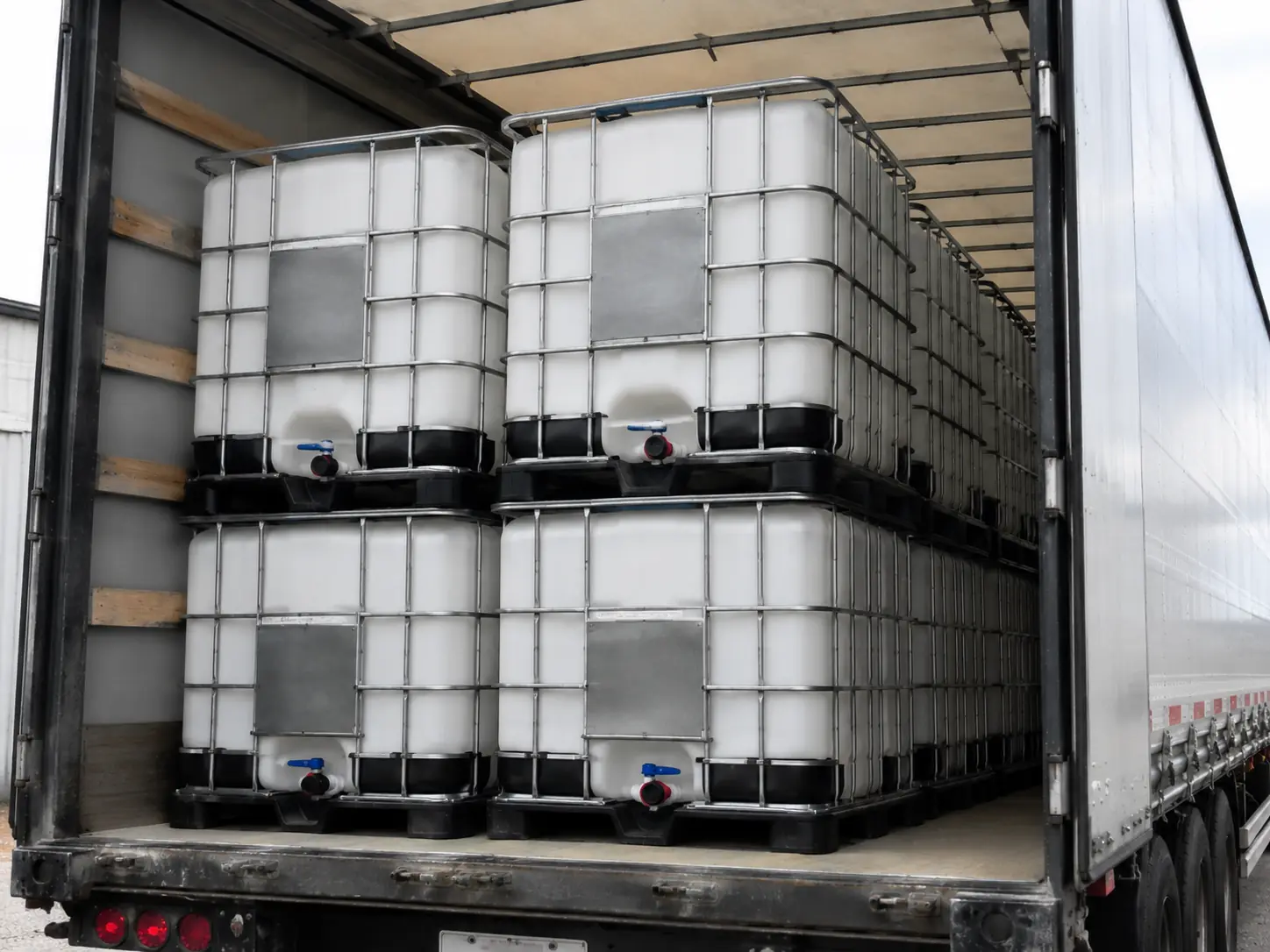
Search for used IBC totes and you will find a great deal of language about being eco-friendly, green and committed to the planet. Almost none of it contains a number, which is convenient, because a claim without a number cannot be wrong.
What we publish and why
Our headline claim is that reusing a 275-gallon composite tote avoids about 125 kg CO₂e against buying the same container new. Here is the whole calculation:
- The container's tare is roughly 59 kg: 17 kg of blow-moulded HDPE and 42 kg of galvanised steel.
- Virgin HDPE, cradle to gate: 1.9 kg CO₂e per kg. 17 × 1.9 = 32.3 kg.
- Virgin galvanised steel, BOF route: 2.2 kg CO₂e per kg. 42 × 2.2 = 92.4 kg.
- Manufacturing and inbound transport allowance: about 15 kg.
- Less the cost of bringing one back — collection, caustic, heated wash water, the return leg: about 15 kg.
- Net: 125 kg, rounded down.
Anybody can check that. If our factors are wrong, someone will tell us, and that is the point.
What we deliberately exclude
<strong>Offsets.</strong> We do not buy them and we would not net them off if we did. An avoided emission and a purchased instrument are different things and mixing them is how claims become meaningless.
<strong>Double counting.</strong> A container cannot be claimed as both a reuse saving and a recycling credit. It gets counted once, at the outcome that actually happened.
<strong>Downstream benefits.</strong> If a customer uses one of our containers for something greener than its previous life, that saving is theirs. It has nothing to do with us and claiming it would be absurd.
<strong>Transport we merely performed.</strong> Moving containers for a third party is a service, not an avoided emission.
The claim we specifically do not make
We are not carbon neutral and we do not say we are. We run trucks, we heat water, we use caustic. What we do is displace a larger emission than the one we create, and that is a defensible thing to say. 'Carbon neutral' would not be.
Uncertainty, honestly stated
Treat everything at ±15%. The largest source of error is the assumed tare split between HDPE and steel, which varies by manufacturer and pallet type. We round every component down, so the true figure is more likely above our numbers than below — but we would rather be quietly conservative than loudly wrong.
These figures have not been third-party verified. We say so on the page rather than hoping nobody asks.
If you need something auditable
The calculator on our site gives an order-of-magnitude figure that is fine for an internal report or a directional claim. For a CDP submission, a Scope 3 line item or a customer audit, ask us for a per-shipment worksheet: actual containers, actual distances, actual wash cycles, built from your manifest rather than from averages.
It takes us a day and it produces something an auditor can follow line by line. That is a very different document from a marketing page, and pretending otherwise does nobody any favours.
Priya Raghunathan is the compliance & documentation at IBC Tote Recycling NY in Astoria, Queens. We publish the figures we work from — if you think one of them is wrong, tell us.